


🎧 Morning Brief #115 - audio debate on today’s market setup
Since January 14, Bitcoin's exchange reserve has been steadily rising amid mixed netflows - a bearish structural signal: coins are returning to exchanges, supply pressure persists.
TL;DR
This brief covers the buildup of Bitcoin exchange supply over the past 45 days. As long as cumulative netflow remains positive, the potential for sustained price growth stays limited.
Bitcoin Exchange Reserve - All Exchanges (Daily)
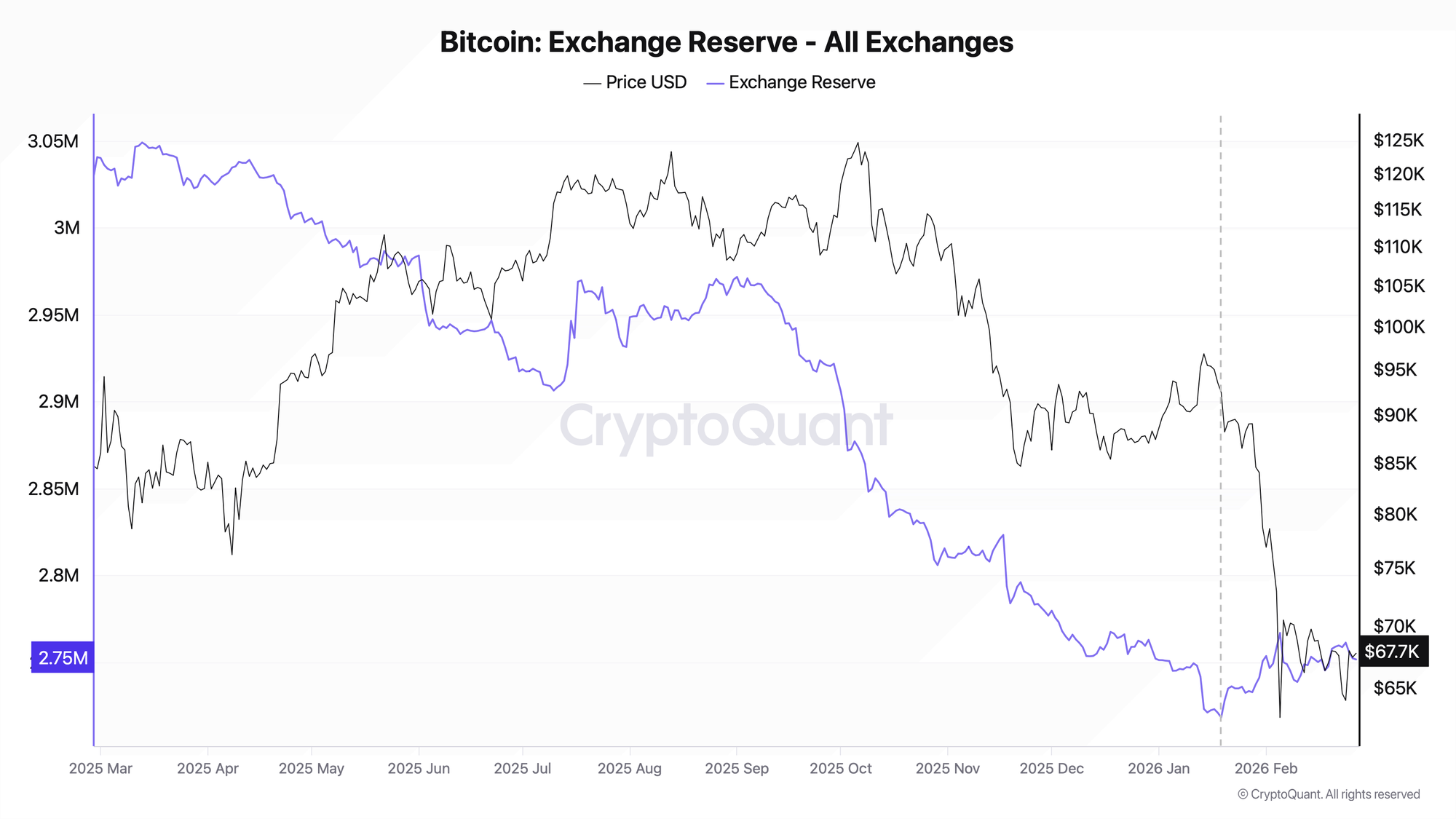
Metric: total BTC held on all major exchange balances.
Since January 14, the exchange reserve has grown from 2.723M to 2.752M BTC - a total increase of approximately 28,489 BTC (+1.0% over 45 days). The move has been uneven: in the first week of February, the reserve reached a local peak near 2.794M BTC on the back of an inflow wave, followed by a pullback - however, by late February the reserve has re-established itself near the upper bound of the range. The growth structure is stepwise - the reserve has not declined back to levels seen at the start of the period, which points to a persistent return of coins to exchanges.
Rising exchange reserve is a classic signal of growing potential supply in the market: coins are arriving at exchanges faster than they are leaving. Until the reserve turns lower and breaks back below 2.723M BTC, structural selling pressure remains intact. The key trigger for a regime change is a sustained decline in the reserve below the January lows.
Bitcoin Exchange Netflow (SMA-30) - All Exchanges
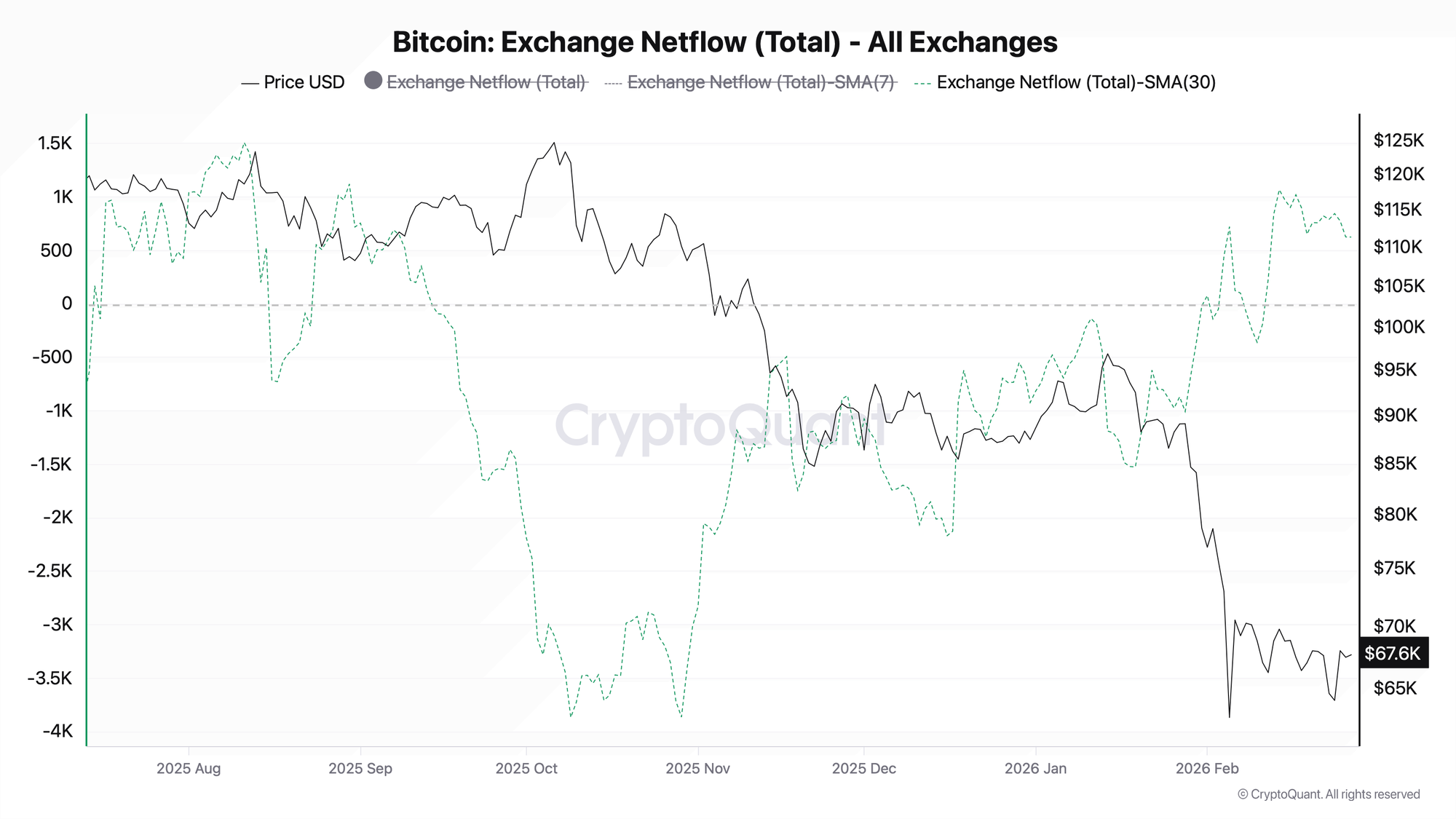
Metric: 30-day moving average of daily netflow (Inflow - Outflow). Positive values indicate a structural inflow of coins to exchanges; negative values indicate sustained outflow and a sign of accumulation.
On January 14, the SMA(30) Netflow stood at -1,187 BTC, consistent with a multi-month regime of coin withdrawal from exchanges. Throughout January, the moving average recovered steadily: by month-end it approached the zero line, and on February 1 it crossed above it for the first time, establishing itself in positive territory. As of February 27, SMA(30) stands at +628 BTC - a sustained positive regime that has held for nearly four consecutive weeks. The local impulse peaked on February 14 at +1,069 BTC, after which the indicator pulled back modestly but did not breach zero.
The SMA(30) Netflow crossing above zero is a signal of structural regime change: the market has transitioned into a mode of elevated coin inflow to exchanges, pointing to intensifying distribution pressure. Four weeks of sustained positive readings rule out a false signal and confirm the durability of the new regime. The key trigger for a return to bullish sentiment is a move back below zero in SMA(30) - until that happens, exchange supply pressure structurally dominates.
Both charts deliver a consistent signal: the reserve has grown by +28K BTC since January 14, and the SMA(30) Netflow confirms this is not a random spike but the result of a sustained structural transition. The SMA(30) regime shift from negative to positive directly explains why the reserve is not declining: coins are arriving at exchanges faster than they are leaving, at an average rate of 628 BTC per day.
Adler Education 📚 On-Chain Fundamentals for Humans | Part 8 -> Exchange Flows: Inflow, Outflow, and Netflow Without the Myths
FAQ
Why is a rising exchange reserve a bearish signal? The exchange reserve represents coins available for immediate sale. When the reserve rises, available supply in the market increases: holders are moving BTC onto exchanges, increasing the volume of coins that could potentially be sold. This creates structural pressure on price until demand absorbs the excess.
Under what conditions will the bearish signal be invalidated? The key condition is a return of SMA(30) Netflow below zero alongside a decline in the exchange reserve back below the start-of-period level of 2.723M BTC. This would indicate that Outflow is once again structurally exceeding Inflow - a sign of a transition back to accumulation and a bullish shift in the supply balance.
CONCLUSIONS
Since January 14, Bitcoin's exchange reserve has grown by 28,489 BTC, while SMA(30) Netflow has reversed from -1,187 to +628 BTC, crossed zero on February 1, and held in positive territory for nearly four weeks - a structural confirmation of the transition to a regime of elevated coin supply on exchanges. The overall verdict is cautiously bearish: exchange supply pressure is confirmed by two independent metrics. The primary trigger for a position reassessment is a return of SMA(30) below zero accompanied by a reserve reversal; the primary risk is a further rise in SMA(30) above current levels, which would accelerate the buildup of exchange supply and create additional downward pressure on price.