


🎧 Morning Brief #118 - audio debate on today’s market setup
The derivatives market is showing a significant shift: over the past two weeks, funding rates on Bitcoin Perpetuals have remained persistently in negative territory, while open interest in USD has fallen by more than half from the October peaks. Both charts tell the same story from different angles - market positioning is clearly shifting toward pessimism, and leverage has largely exited the system.
TL;DR
Funding has been persistently negative for the second week in a row - short positions dominate the derivatives structure. Open interest has declined from $47.6B to $20.8B, signaling a major deleveraging event - the market has unloaded, but sentiment remains bearish.
Bitcoin Perpetual Funding Rates
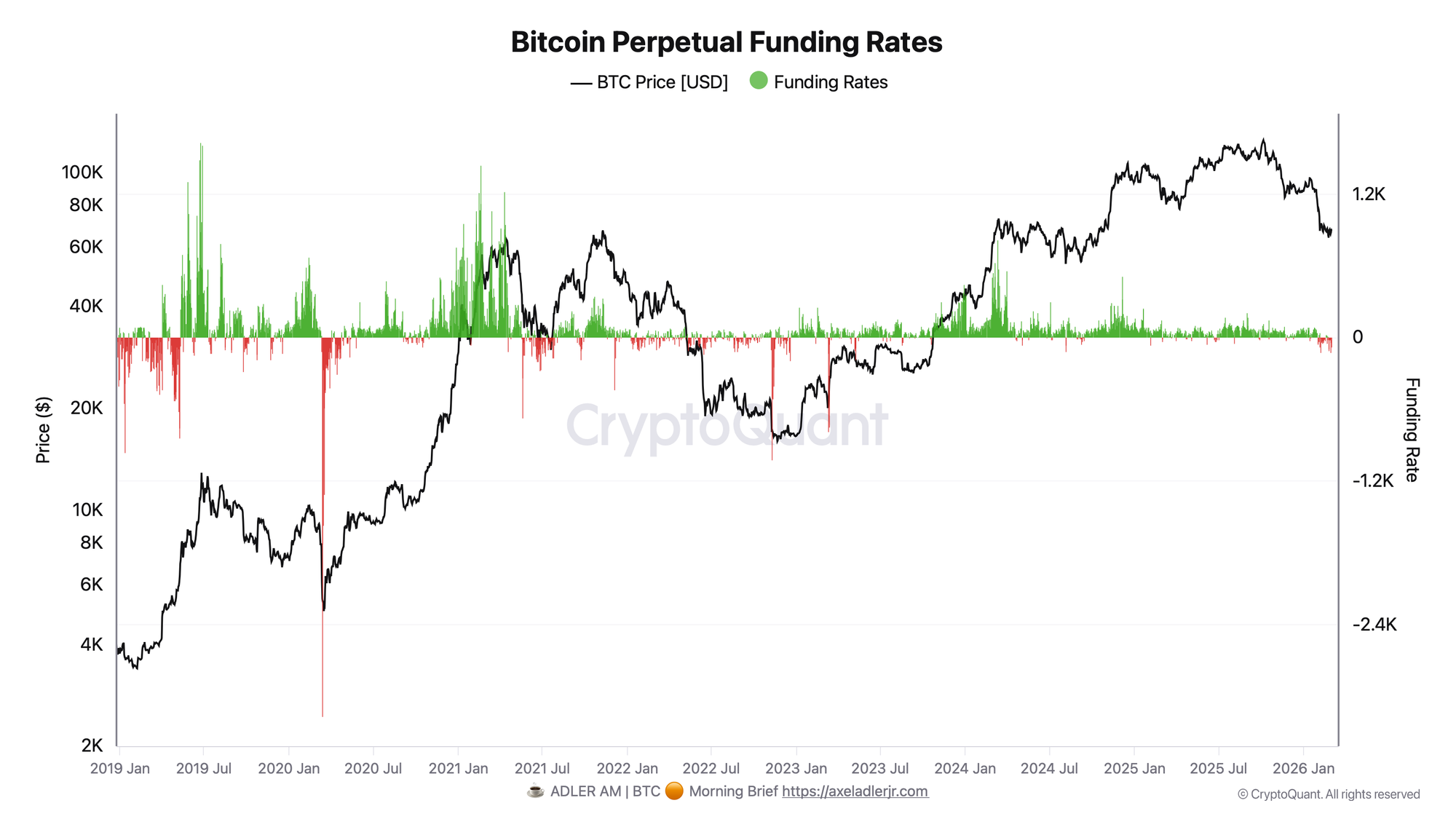
Since late January, funding has frequently dipped into negative territory, and over the past two weeks it has remained there with almost no recovery. The most extreme readings were recorded on February 28 and February 25 - the days when price was testing local lows around $64-65K. As of March 4, the rate remains slightly negative, but the two weeks of accumulated negative funding indicate a persistent positioning skew toward shorts.
Negative funding means that holders of short positions pay long holders to maintain their contracts - a sign of positioning skew toward shorts, which has historically preceded either a short squeeze on any upside impulse, or confirmation of the bearish trend if the decline continues. The key trigger for a sentiment reversal is a return of funding to persistently positive values alongside price consolidation above key resistance (around $70K) and stabilization or growth in OI.
Bitcoin Futures Open Interest

Futures open interest in USD has fallen by more than half from the October 2025 peak ($47.6B) and by roughly a third from the January high ($32.0B). As of March 4, OI stands at $20.8B - levels last seen before the 2025 rally. Over the past 7 days, OI declined an additional 3.2% - deleveraging continues, though the pace has slowed.
A decline in OI alongside a falling price is a signal of forced or voluntary position closing, meaning the market is genuinely unloading. This distinguishes the current situation from a classic short squeeze scenario: at lower OI levels, there is typically less mechanical fuel for a liquidation cascade, though localized squeezes remain possible. The risk of a further downside liquidation cascade is lower than it was in January.
Together, the two charts paint a more nuanced picture than it might first appear: leverage has left the market (OI fell from $47.6B to $20.8B), yet remaining participants are positioned predominantly short (negative funding). This combination reduces the risk of a cascading downside deleveraging, but also limits the potential for an organic short squeeze - there is less fuel in the system.
📚 Start with the structured path: Two Hours to Understanding Bitcoin A 6-block reading guide built from the Education series. Macro → On-chain basics → Levels → Thermometer → Supply → Flows. Each block is one article, one concept, one skill.
FAQ
What does persistently negative funding mean for near-term market direction? Negative funding is not a reversal signal in itself - it simply reflects the skew of short positioning. Historically, prolonged negative funding during a declining OI environment has preceded price stabilization, as selling pressure through derivatives eases. Without the emergence of new demand, however, the market can remain in this regime for weeks.
Under what conditions will the current regime end, and how will it be recognized? A reversal will be confirmed when two conditions are met simultaneously: funding returns to positive territory and price consolidates above key resistance levels with OI rising. Rising OI alongside positive funding will signal a return of long interest into the system - the most bullish scenario available.
CONCLUSIONS
The derivatives market has undergone a major deleveraging: open interest has fallen from $47.6B to $20.8B - more than half from its peak. Remaining positions are skewed toward shorts, as indicated by persistently negative funding over the past two weeks. The current stance is neutral with a cautious bias: price has stabilized in the $65-68K range, the derivatives structure does not provide a signal for confident long positioning, but the risk of a cascading downside liquidation has also declined significantly compared to January. The key trigger for a regime change is a return of funding to positive territory alongside simultaneous growth in OI and price. The key risk is continued decline in the absence of new demand: lower OI limits the amplitude of moves, but does not cancel the bearish structure.
Further Reading
If you want to go deeper on the metrics covered in this brief, the full framework for reading open interest alongside price divergences is covered in the guide to Bitcoin Open Interest & Leverage Ratio, and the mechanics of funding rates - including historical cycle signals - are explained in Bitcoin Funding Rates: Definition, Formula & Cycle Signals.
For the combined framework that uses both metrics together, see Bitcoin Open Interest and Funding Rate. The conditions that turn negative funding and high OI into a cascade are detailed in Bitcoin Liquidation Cascade: How It Works and How to Predict It.