


🎧 Morning Brief #112 - audio debate on today’s market setup
Bitcoin is trading below $64K as capital continues to leave the network. Two indicators - Realized Cap dynamics and HODL Waves structure - point in the same direction: the market is in a defense phase where old coins are held but new capital is not entering.
TL;DR
Realized Cap has been declining for the second consecutive month, while the 3-6 month cohort surged sharply as coins bought near the peak matured into it. This is a defense phase, not accumulation - with net capital flow remaining negative, there is no bullish reversal signal.
Bitcoin Realized Cap Net Position Change (%)
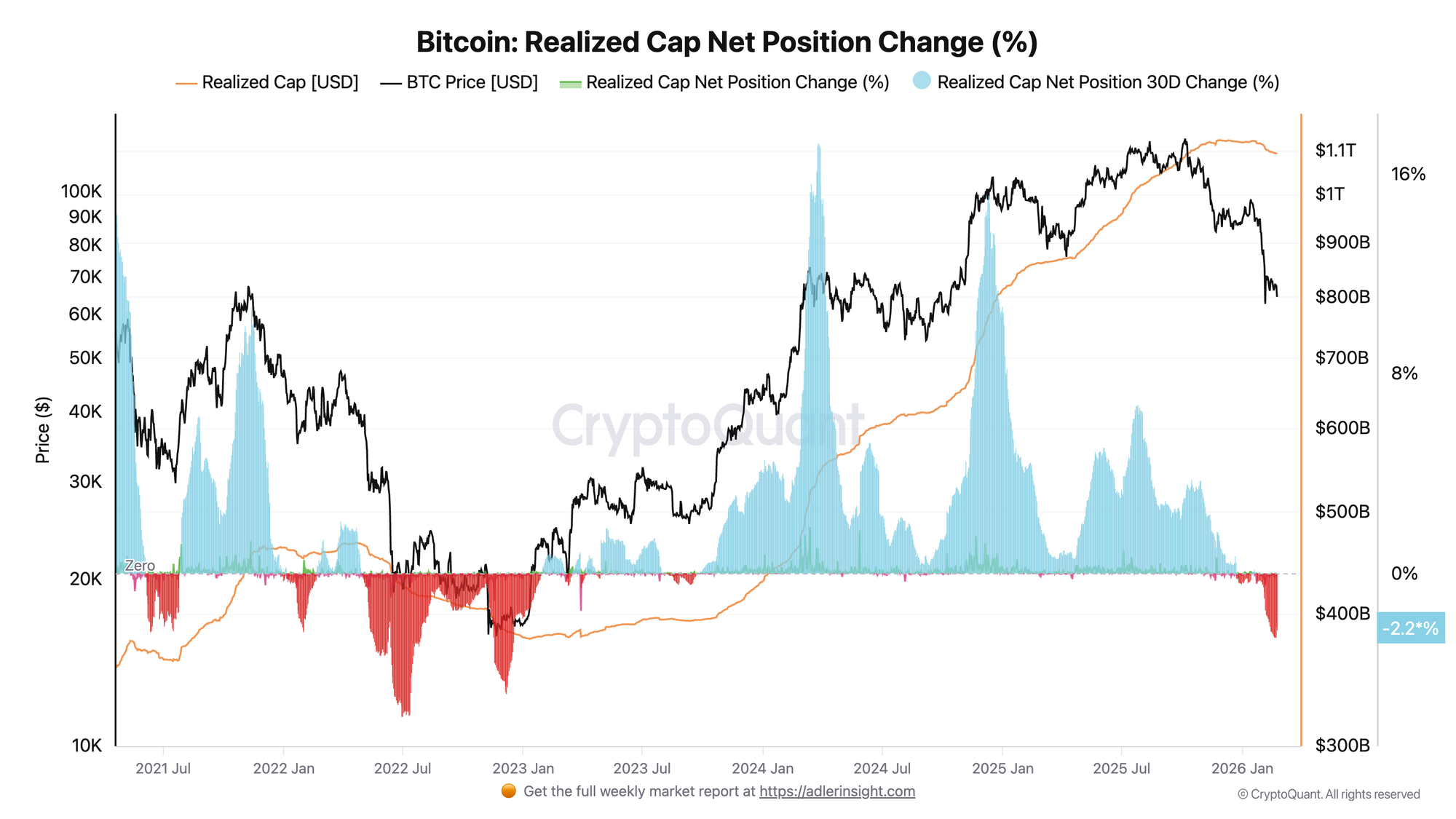
Realized Cap is the aggregate value of all coins at the price of their last movement. A negative change means capital is leaving the network: coins are moving at prices below their cost basis, or incoming capital is not offsetting the outflow.
The 30-day Realized Cap change stands at -2.26% and has remained in negative territory for several consecutive weeks. Realized Cap peaked on November 26, 2025 at $1.127T; it has since declined to $1.094T - a compression of approximately $33B. Daily Net Position Change values fluctuate around zero or move negative, indicating the absence of sustained new capital inflow.
As long as the 30-day metric remains negative, the network is in net outflow mode. A reversal into positive territory would be the first signal of renewed accumulation demand. The key trigger for a regime change is a sustained return above zero held over several days.
Bitcoin HODL Waves
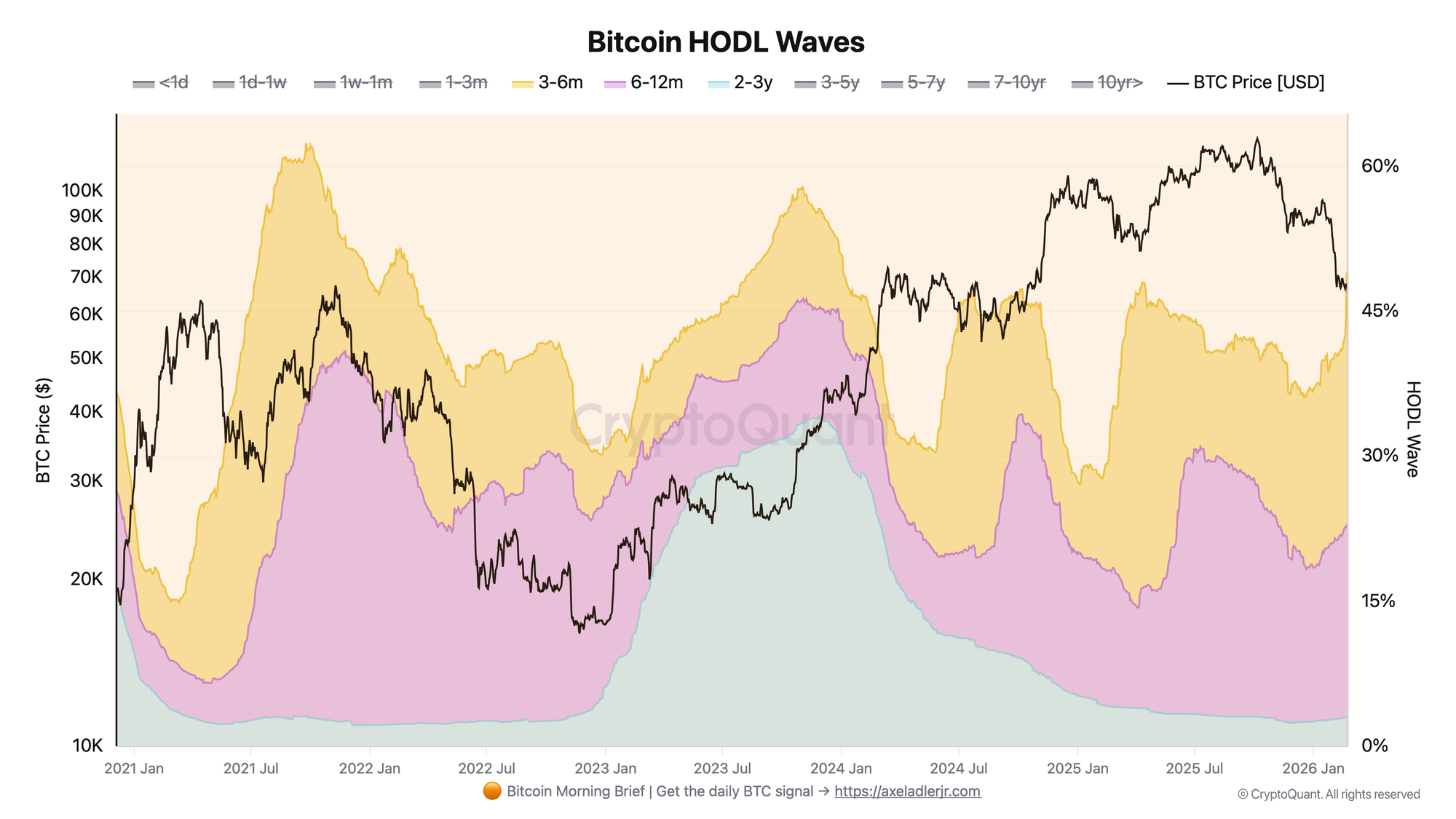
HODL Waves show the distribution of coins by age since last movement. Growth in older cohorts means coins are not moving: holders are not selling, but new buyers are not appearing either.
The 3-6 month cohort surged sharply from ~19% at the start of February to 25.9% as of February 24. These are coins that last moved in August-November 2025 - predominantly purchases made near or at the peak of the previous rally. At the same time, the 6-12 month cohort is also expanding to 20.2%, while the share of short-term coins (under 1 month) remains minimal at approximately 9.3% combined. Fresh supply in the market is nearly absent.
The HODL Waves structure describes a classic "costly hold" phase: large cohorts of coins were bought above current prices and are frozen in place. This is not smart money accumulating at the lows - this is forced holding of underwater positions. A positive shift will appear when the 3-6 month cohort begins migrating into longer-term bands without accompanying selling pressure.
Both charts point in the same direction: supply is aging, but capital is not returning to the network. HODL Waves capture a structure where the largest cohort consists of coins bought near the peak and now sitting at a loss. Realized Cap confirms that these positions are weighing on the network with negative net flow. As long as both conditions hold simultaneously, the market remains in defense mode.
🔸 Outperform Buy & Hold with a rules-based strategy - Start free. One weekly action, clear triggers, and invalidation levels. No guessing.
FAQ
Why is the growth of the 3-6 month cohort a weakness signal rather than a strength signal?
Normally, growth in older cohorts is interpreted as accumulation. However, in this case Realized Cap peaked in November 2025, and coins that moved at that time are now maturing into this cohort after 3-6 months - with the current price below their cost basis. This is forced holding of losing positions, not deliberate accumulation at low prices.
What needs to happen for the regime to change?
Two conditions must be met simultaneously: the 30-day Realized Cap change must sustainably return above zero (new capital inflow), and the share of short-term cohorts (under 1 month) must begin growing, signaling the emergence of new buyers. Holding the current price level without these two triggers is not a bullish signal.
Further Reading
- Bitcoin Realized Price Bands Explained: Cycle Analysis, Signals, and Historical Examples
- Bitcoin NUPL (Net Unrealized Profit/Loss): What It Is and How to Use It
- Bitcoin LTH vs STH: Supply Dynamics, Cost Basis & Market Structure
CONCLUSIONS
Realized Cap is declining from the November peak of $1.127T, recording sustained capital outflow with a 30-day metric of -2.26%. HODL Waves complete the picture: the largest market cohort - coins aged 3-6 months at a 25.9% share - represents positions opened near the highs that are now underwater. Together, this describes a defense phase: holders are not capitulating, but new capital is not arriving. The regime remains neutrally defensive until a clear reversal of Realized Cap into positive territory appears; the primary risk is continued price pressure in the absence of new buyers capable of absorbing the supply.