


🎧 Morning Brief #129 - audio debate on today’s market setup
In February-March 2026, stablecoin liquidity began to recover, but exchange demand has not yet returned to its previous pace. The 30DMA of USDC and USDT inflow to exchanges declined from the February peak of $3.9B to $2.74B by March 19, while the 30-day change in combined stablecoin market capitalization reversed from -$8.1B to +$4.5B. Both charts show different stages of the same process: capital is already returning to the ecosystem, but has not yet translated into sustained BTC demand through exchanges.
TL;DR
Stablecoin market cap reversed from -$8.1B to +$4.5B, signaling a recovery of dollar liquidity in the ecosystem. But USDC and USDT exchange inflow remains weak: the 30DMA has fallen to 0.68x of the annual norm. The reversal is already underway. The key question now is whether it will grow into real risk-on demand for BTC.
USDC and USDT All Exchange Inflow [USD] ERC-20
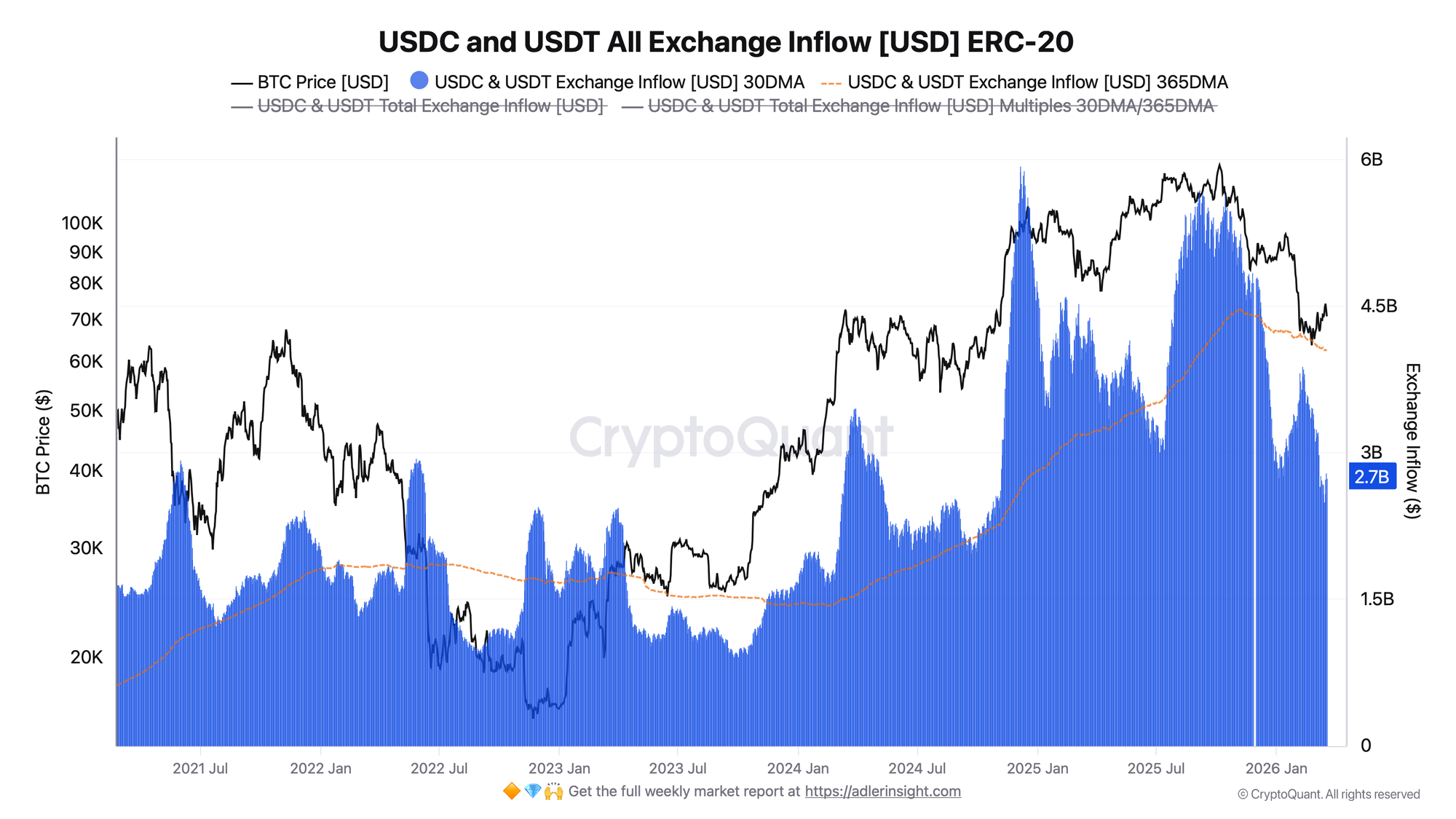
In early February, the 30DMA of USDC+USDT exchange inflow accelerated alongside BTC's rise and reached a local peak of $3.89B on February 10. After that, the metric began a steady decline and by March 19 had fallen to $2.74B, which is 29.4% below the February high. Against this backdrop, the 365DMA remains at $4.05B, and the current 30DMA/365DMA ratio stands at 0.677. This means that the current stablecoin inflow to exchanges remains noticeably below its annual norm.
The decline in 30DMA inflow alongside the BTC correction shows that exchange demand from stablecoins weakened more than the price itself. This does not necessarily mean capital is leaving the ecosystem - the second chart shows the opposite. But it does mean that new capital is not yet translating into aggressive spot demand for BTC. Historically, a return of the 30DMA above the 365DMA has more often coincided with a recovery phase in risk appetite. The gap to that level currently stands at approximately $1.3B.
30-Day Change in USDT and USDC Market Capitalization
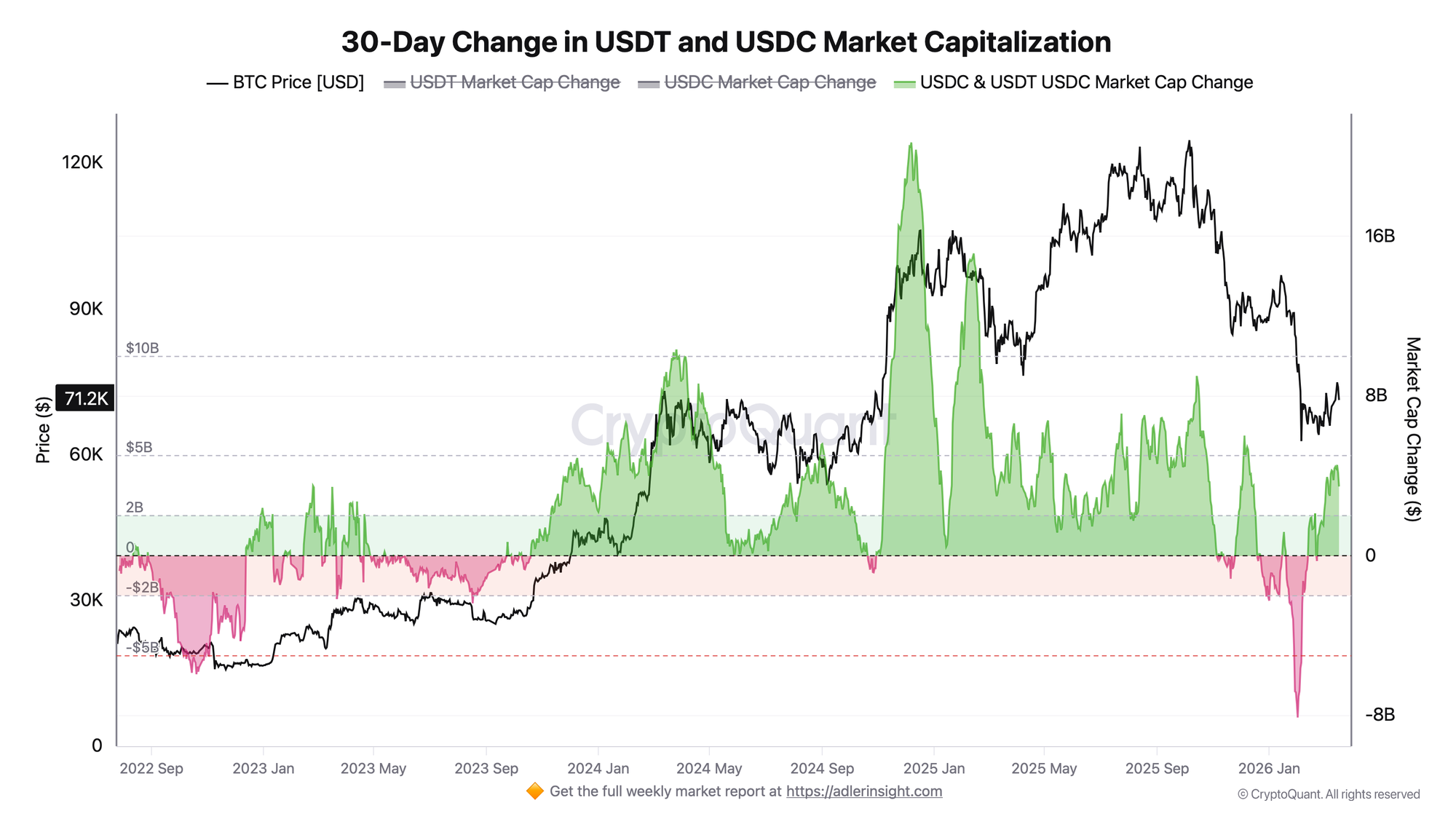
On February 1, 2026, the combined 30-day change in USDT+USDC market capitalization reached -$8.1B - the worst reading since 2022. The metric then began to recover: by mid-February it returned to positive territory, and in March the recovery accelerated. By March 16, the combined gain peaked at $4.54B.
The recovery has so far been driven primarily by USDC, while USDT's contribution remained limited for several more weeks. This is an important detail: dollar liquidity is genuinely returning to the ecosystem, but unevenly so far. Growth in stablecoin market cap alone does not yet imply an immediate shift to BTC buying. Some capital may remain in wallets, flow into DeFi, or wait for a stronger market confirmation.
Taken together, both charts show a key shift: capital has already returned to stablecoins, but has not yet converted into the previous volume of exchange inflow. The liquidity is there, but it has not yet turned into a full trading impulse.
Buy and Hold works until the wrong 30% drawdown destroys your confidence. Weekly Engine helps you stay exposed when conditions are healthy and step aside when risk starts rising - so you can follow a process instead of guessing under pressure. Start 7 days free.
FAQ
Why is the growth in stablecoin market cap not accompanied by an increase in exchange inflow? Growth in market cap reflects an expansion of dollar liquidity within the crypto ecosystem, but does not indicate that these funds are immediately being used to buy BTC. Some capital may remain off exchanges, be distributed across DeFi, or simply be waiting for a more favorable entry point. Exchange inflow is a stricter indicator because it shows capital that is already approaching active use in trading.
Under what conditions will this reversal become a bullish signal for BTC? The first condition is a return of the 30DMA exchange inflow above the 365DMA - that is, above approximately $4.05B. The second is more sustained USDT participation in the market cap recovery. Such a combination would signal not just growth in system liquidity, but its transition into broader and confirmed market demand.
CONCLUSIONS
February-March 2026 so far looks like a liquidity recovery phase, not a full acceleration phase. Combined stablecoin market cap has already reversed from -$8.1B to +$4.5B, confirming the return of capital to the ecosystem. But USDC and USDT exchange inflow remains weak: the 30DMA stands at just $2.74B, or 0.68x of the annual norm, with a deficit of approximately $1.3B to the 365DMA level.
The current regime can be described as follows: capital has returned to stablecoins, but has not yet returned in full to exchanges. The key bullish trigger is a recovery of the 30DMA above the 365DMA with broader USDT participation. The key risk is a slowdown in market cap recovery before exchange inflow has had a chance to confirm a transition to stronger BTC demand.
Further Reading
- Stablecoin Market Cap (USDT & USDC): Definition, Formula & Bitcoin Cycle Signals
- Bitcoin STH SOPR: What It Is and How to Use It
- Bitcoin Exchange Netflow: What It Is and How to Use It
- Bitcoin Stablecoin Supply Ratio (SSR): Definition, Formula & Cycle Signals
- Bitcoin NUPL (Net Unrealized Profit/Loss): What It Is and How to Use It