


After sentiment peaked at 88.11 in late August, the Unified Sentiment Index fell to 70.05 and remains in the extreme greed zone. Meanwhile, BTC is trading at $77.6K and has not shown a comparable acceleration.
TL;DR
Sentiment remains significantly above its annual norm despite the latest impulse cooling. The component breakdown shows that the extreme reading is driven primarily by the Fear & Greed Index, while participant votes provide a much more moderate signal.
Bitcoin Unified Sentiment
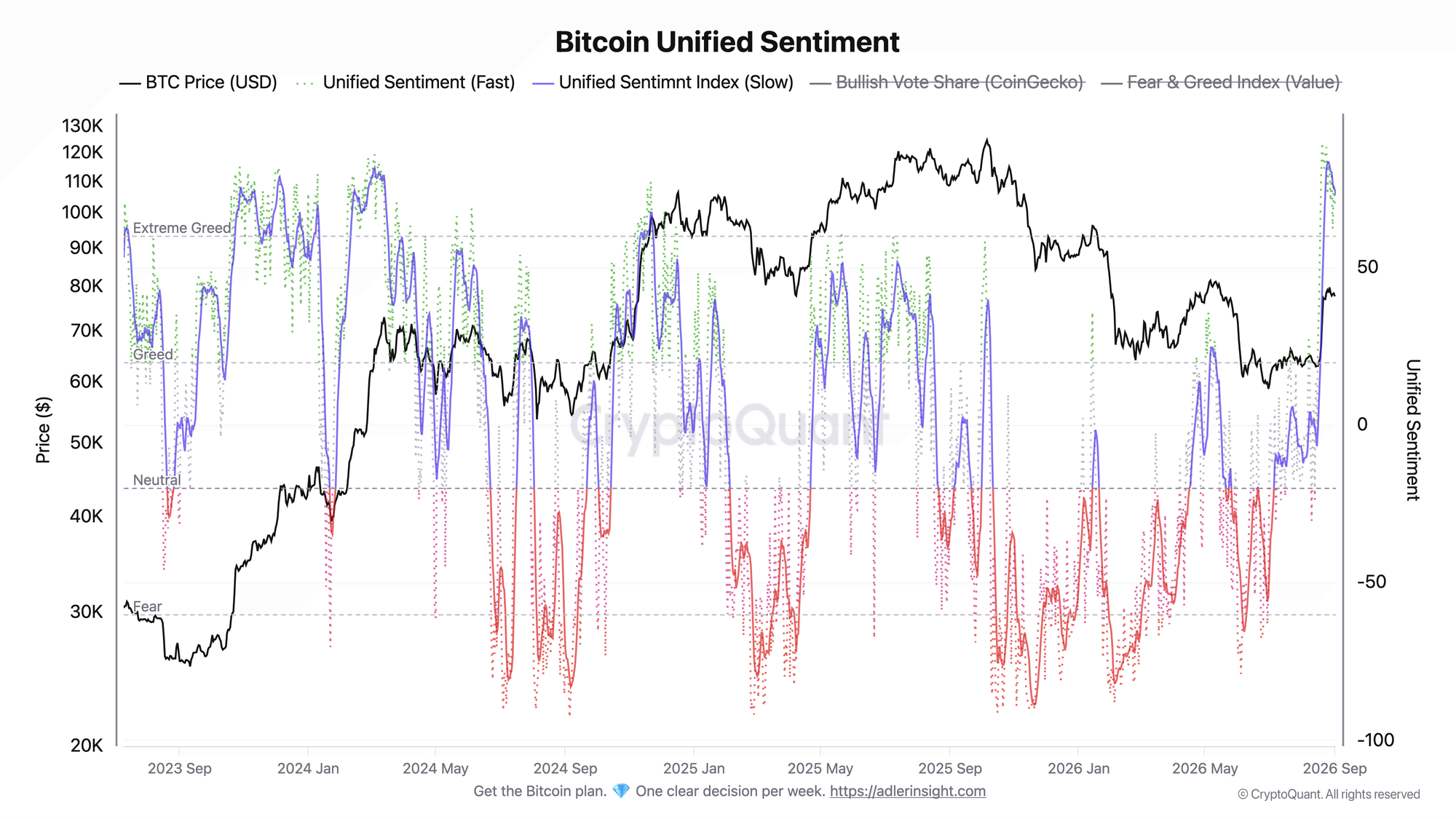
The fast sentiment index reached 88.11 on August 24 before falling to 70.05 by September 2. Its 7-day version has also turned lower and now stands at 72.94, although both readings remain above the extreme greed threshold. BTC was trading at $77.64K on September 1, compared with $78.68K on August 24, meaning the rise in sentiment was not accompanied by a comparable continuation of price momentum.
Sentiment is already cooling, but the regime remains far from normalized. A high index reading alone is not a bearish signal, but the combination of extreme optimism and a lack of price follow-through makes the market more sensitive to weakening demand.
Bitcoin Sentiment Components
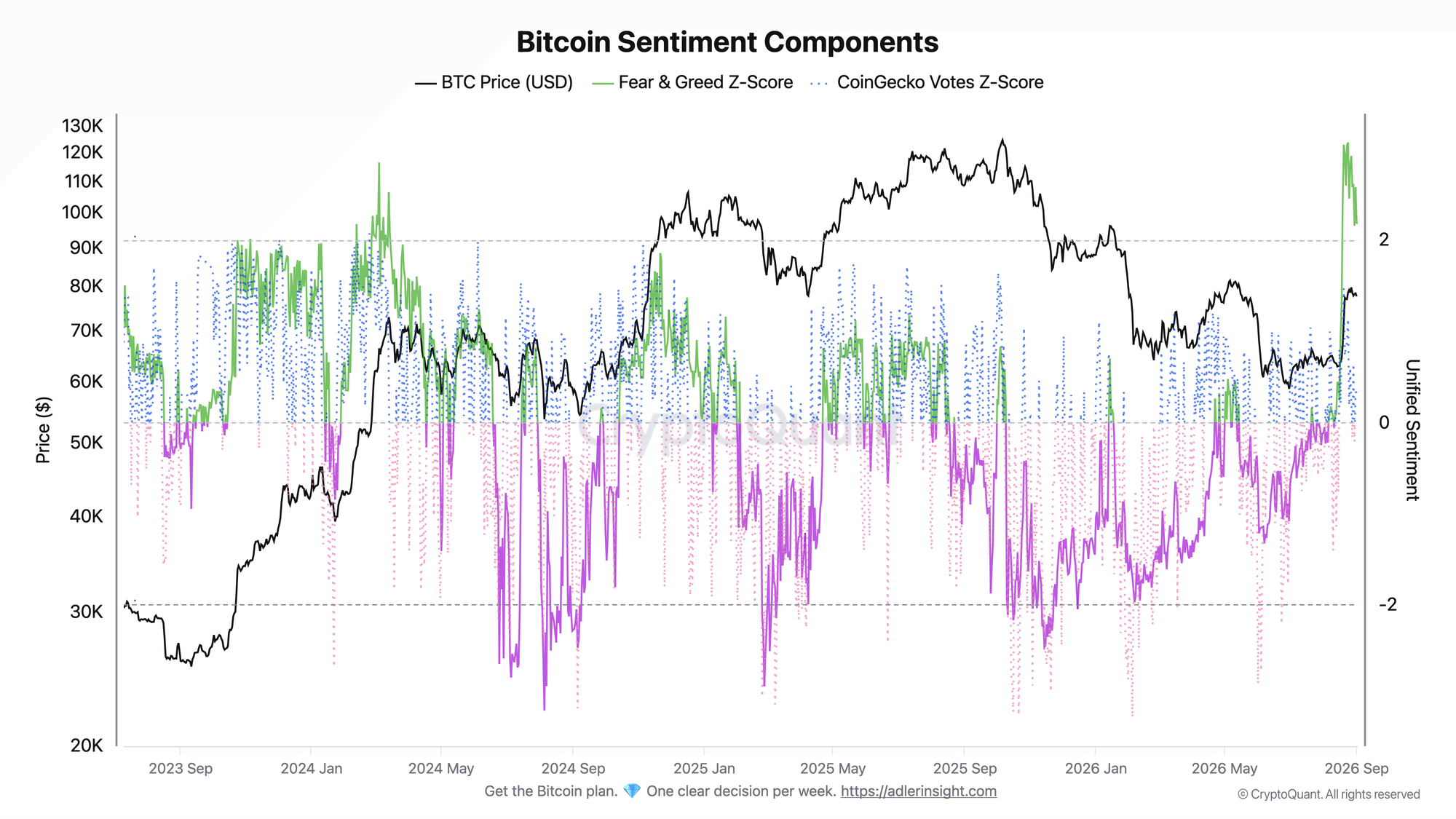
The breakdown shows what is driving the high composite index. The Fear & Greed Index Z-score stands at +2.19σ, meaning the reading is more than two standard deviations above its 365-day norm. Meanwhile, the CoinGecko Votes Z-score is only +0.34σ, indicating moderate rather than extreme optimism among this group of participants.
This is an important difference: the current extreme greed reading is neither broad nor equally strong across both components. The high Unified Sentiment reading is now largely driven by how far the Fear & Greed Index has moved above the weak backdrop of the past 365 days. The first chart therefore shows overheated sentiment, while the second reveals a much less uniform internal structure.
Invest in Bitcoin without emotional decisions. Deterministic signals built to remove fear, FOMO, and panic selling. Join Weekly Engine.
FAQ
Why does the index show extreme greed if the market does not look euphoric? Because the model measures deviation from its own 365-day norm rather than the absolute level of sentiment. After a prolonged period of weak sentiment, even a moderately high absolute reading can become statistically extreme relative to the previous year.
What would confirm a more sustainable positive regime? Price must begin confirming elevated sentiment through its own momentum, while the improvement must broaden across the components. It is especially important for participant votes to stop lagging significantly behind the Fear & Greed Index.
CONCLUSIONS
The Unified Sentiment Index has fallen from its recent extreme but remains deep in the greed zone, while price has yet to confirm a comparable acceleration. At the same time, the component breakdown shows a strong asymmetry: the Fear & Greed Index is above +2σ, while CoinGecko Votes are only moderately above their annual norm. The overall market sentiment regime remains overheated. The main positive trigger would be a simultaneous expansion in price momentum and confirmation from both components, while the main risk is that extreme sentiment persists without corresponding growth in demand and price.
Live Charts
Explore the metrics behind this brief with live, auto-updating charts:
Fear & Greed Index - Composite market sentiment for risk appetite and sentiment extremes.
NUPL - Net unrealized profit/loss across holders, mapped into cycle sentiment phases.
Supply in Profit - Share of circulating supply in profit as a cycle-phase and euphoria gauge.
MVRV Ratio - Market value vs realized value to identify valuation regimes and cycle risk.
Coinbase Premium Index - Coinbase vs global market premium as a proxy for US spot demand pressure.