


🎧 Morning Brief #168 - audio debate on today’s market setup
Bitcoin is trading above $80,000, and the STH Loss Pressure metric has dropped to zero for the first time in several months as price recovers. At the same time, the STH share of total BTC supply continues to decline, pointing to a weakening short-term speculative overhang.
TL;DR
STH Loss Pressure has dropped to 0%. At the current level, short-term holders are no longer in unrealized loss territory. At the same time, STH Supply Share has declined to 22%, the lowest level in the past 90 days. The combination of these two metrics shows that April stress among STH has been removed, while the share of price-sensitive supply is shrinking.
STH Loss Pressure (%)
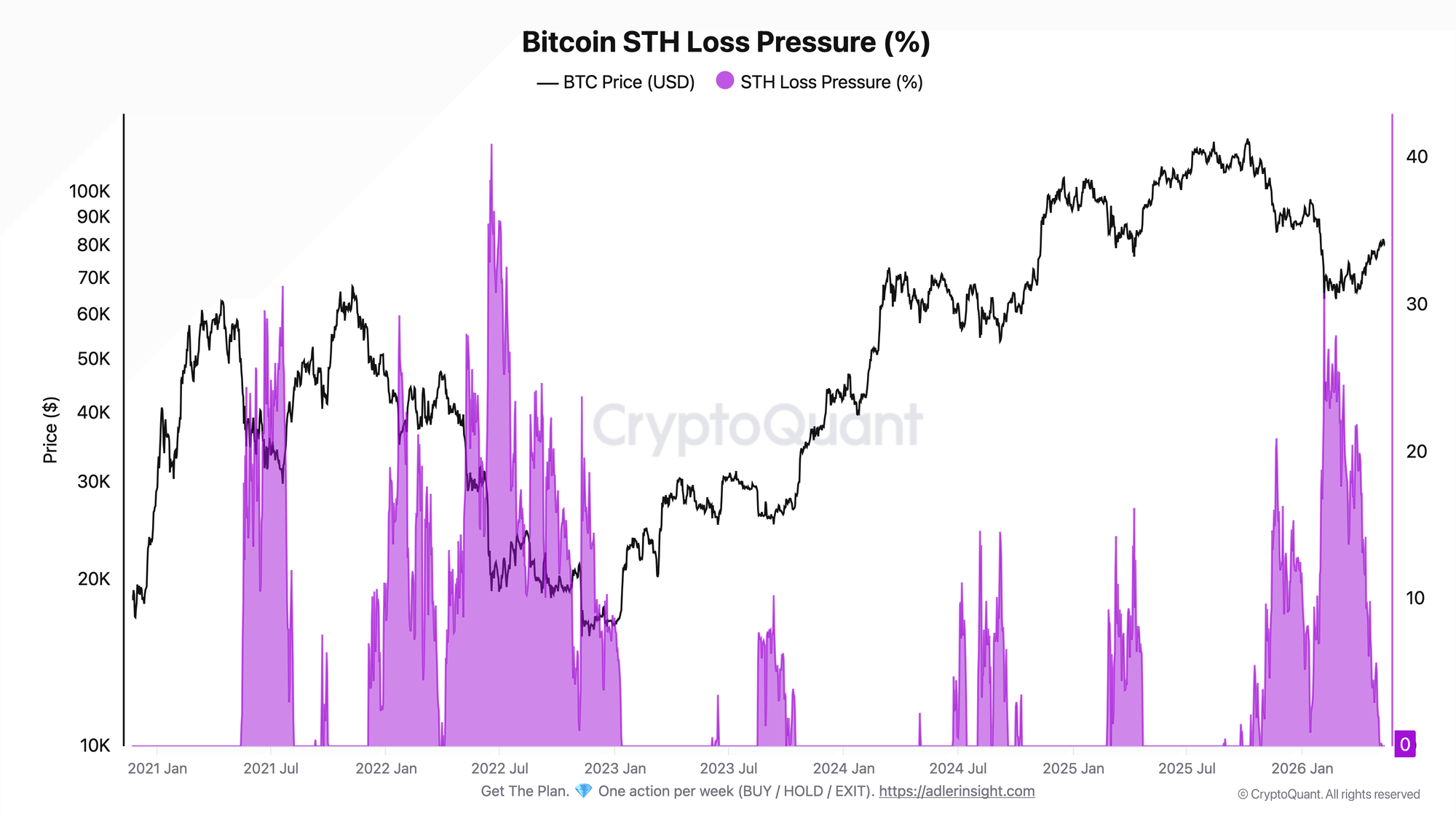
The metric reflects the intensity of unrealized losses within the short-term holder segment. The higher the value, the more STH are “underwater” in dollar terms.
Today, STH Loss Pressure = 0% - for the fifth consecutive day. For context: in late March and early April, the metric was in the 18-22% range, while the local peak over the 90-day window reached 27.9% on February 24.
Throughout April, the STH segment remained under pressure while BTC traded in the $66,000-77,000 range. The return above $80,000 fully neutralized this aggregate loss. The metric dropping to zero means that the total current value of STH supply is once again above its realized value.
This is an important structural shift. The loss overhang from short-term holders has been removed: some sellers already capitulated in April, while the remaining cohort has returned to profit. As long as BTC holds above the STH cost basis, forced selling pressure from underwater STH remains low.
The key deterioration level is $78,000-79,000. A return to this zone could put part of the short-term holder cohort back into loss and revive STH Loss Pressure.
STH Supply Share (%)
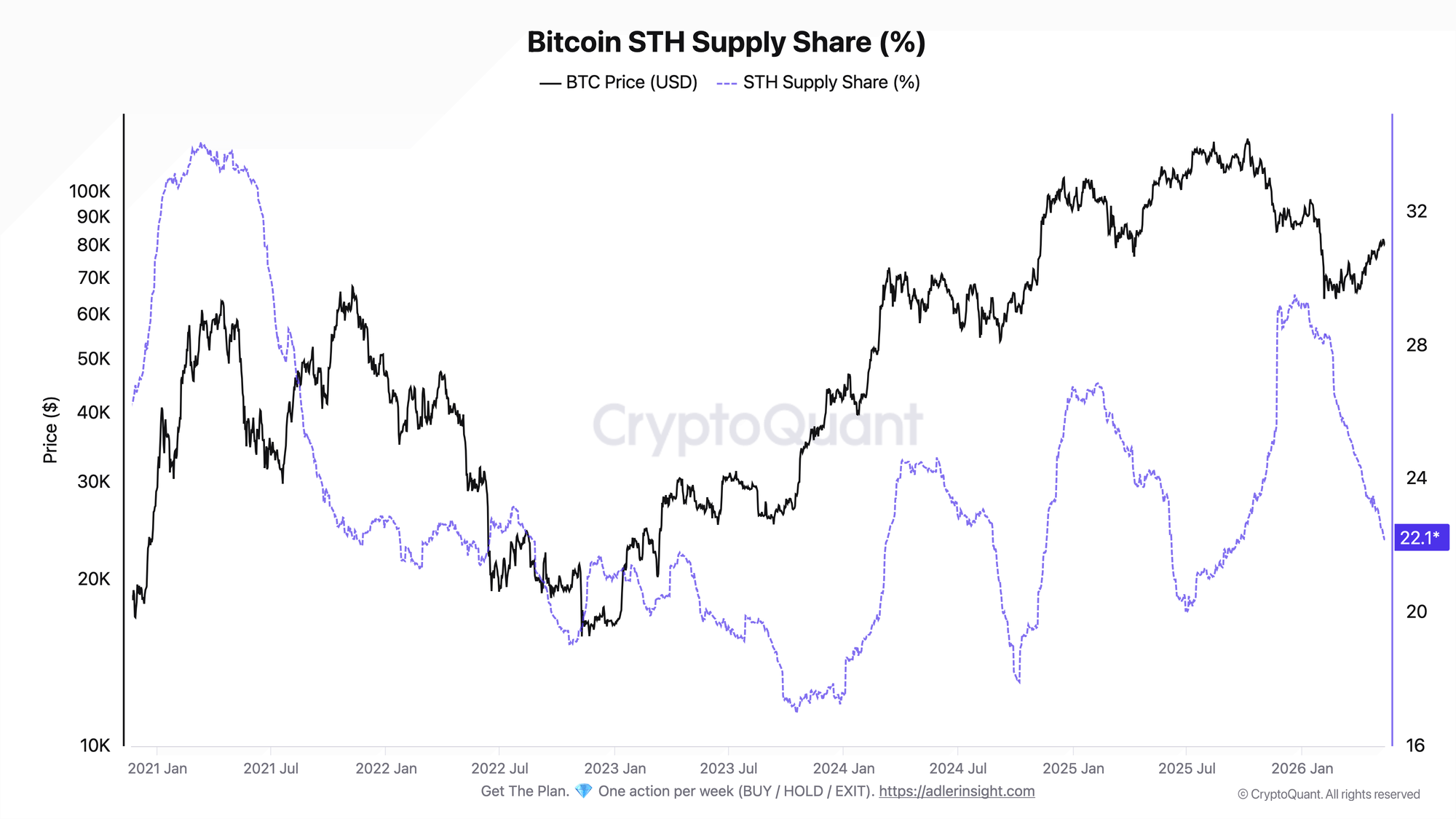
The metric shows what share of total BTC supply belongs to short-term holders, meaning coins younger than 155 days.
The current value is 22.2%, the lowest level in the past 90 days. For comparison, the maximum over this period was 28.3%. The decline has been steady: since the start of May, the metric has gradually fallen from 23.1% to 22.2%.
This means the share of young coins in the supply structure is shrinking. The reason may be the aging of previously purchased coins, lower activity from new buyers, or a redistribution of supply from the more sensitive STH cohort to the more resilient LTH cohort.
A decline in STH Supply Share while price rises is a positive structural signal. The market is rising not because of a sharp expansion in the share of new short-term participants, but while the volume of “hot” supply is shrinking at the same time. This reduces the risk of immediate overhang from recently entered buyers.
The trigger for reassessment is a reversal of STH Supply Share upward. That scenario would signal an inflow of new short-term capital and an increase in the market’s sensitivity to corrections.
Metric Combination
Both indicators show a consistent picture.
STH Loss Pressure shows that stress among short-term holders has been removed: aggregate unrealized loss has dropped to zero. STH Supply Share shows that the short-term cohort itself is shrinking within the supply structure.
Less loss pressure, less “hot” supply, less immediate risk from short-term holders.
Reading the signal is not enough - you need to act on it. Weekly Engine turns on-chain data into one clear decision per week, with risk caps and invalidation built in. Start free.
FAQ
Does zero STH Loss Pressure guarantee further upside? No. The metric describes the current state of stress, not future price direction. A zero reading removes one of the key sources of selling pressure, but it does not eliminate risks from macro, liquidations, exchange inflows, or renewed demand weakness.
Under what scenario would the structure deteriorate again? The main risk is a sustained close below $78,000-79,000. In that case, some recent buyers would move back into loss, and STH Loss Pressure would begin to recover.
The second risk is a reversal of STH Supply Share upward. This would mean the share of short-term participants is increasing, which also means the market’s sensitivity to the first correction would rise.
CONCLUSIONS
April stress among short-term holders is over. STH Loss Pressure has stayed at zero for the fifth consecutive day, while STH Supply Share has declined to 22.2%, the lowest level in the past 90 days.
Market structure has become more resilient: short-term holders are no longer under aggregate loss pressure, while the share of price-sensitive supply is shrinking.
The current stance is cautiously positive. Conditions for continued upside have improved, but confirmation would require BTC to hold above $80,000 while STH Loss Pressure remains near zero and STH Supply Share stays in the 90-day low zone.
The main risk is a return to $78,000-79,000. This level could quickly put part of the STH cohort back into loss and create a renewed seller overhang.
Further Reading
Want to go deeper on the metrics behind today's brief:
- Bitcoin LTH vs STH: Supply Dynamics, Cost Basis & Market Structure - how STH and LTH supply interact across cycle phases
- Bitcoin STH Realized Price: Definition, Formula & Cost Basis Framework - how short-term holder cost basis is calculated and why it acts as a key support/resistance level
- Bitcoin Short-Term Holder Profitability: Break-Even as Bull/Bear Signal - how the STH break-even level functions as a regime switch
- STH vs LTH Realized Price: Support & Resistance Guide - a practical guide to using realized price bands as actionable chart levels