


🎧 Morning Brief #132 - audio debate on today’s market setup
Large transfers to exchanges have intensified again, and the inflow structure in March has sharply shifted toward the 100-1K BTC range. Together, these two signals indicate not just rising exchange activity, but strengthening pressure from large supply precisely when the market remains vulnerable to a new wave of distribution.
TL;DR
Two exchange indicators are synchronously pointing to strengthening large supply. This alone does not confirm a downside reversal, but it notably raises the risk that any rally will be met with more aggressive selling.
Bitcoin: Exchange Whale Ratio
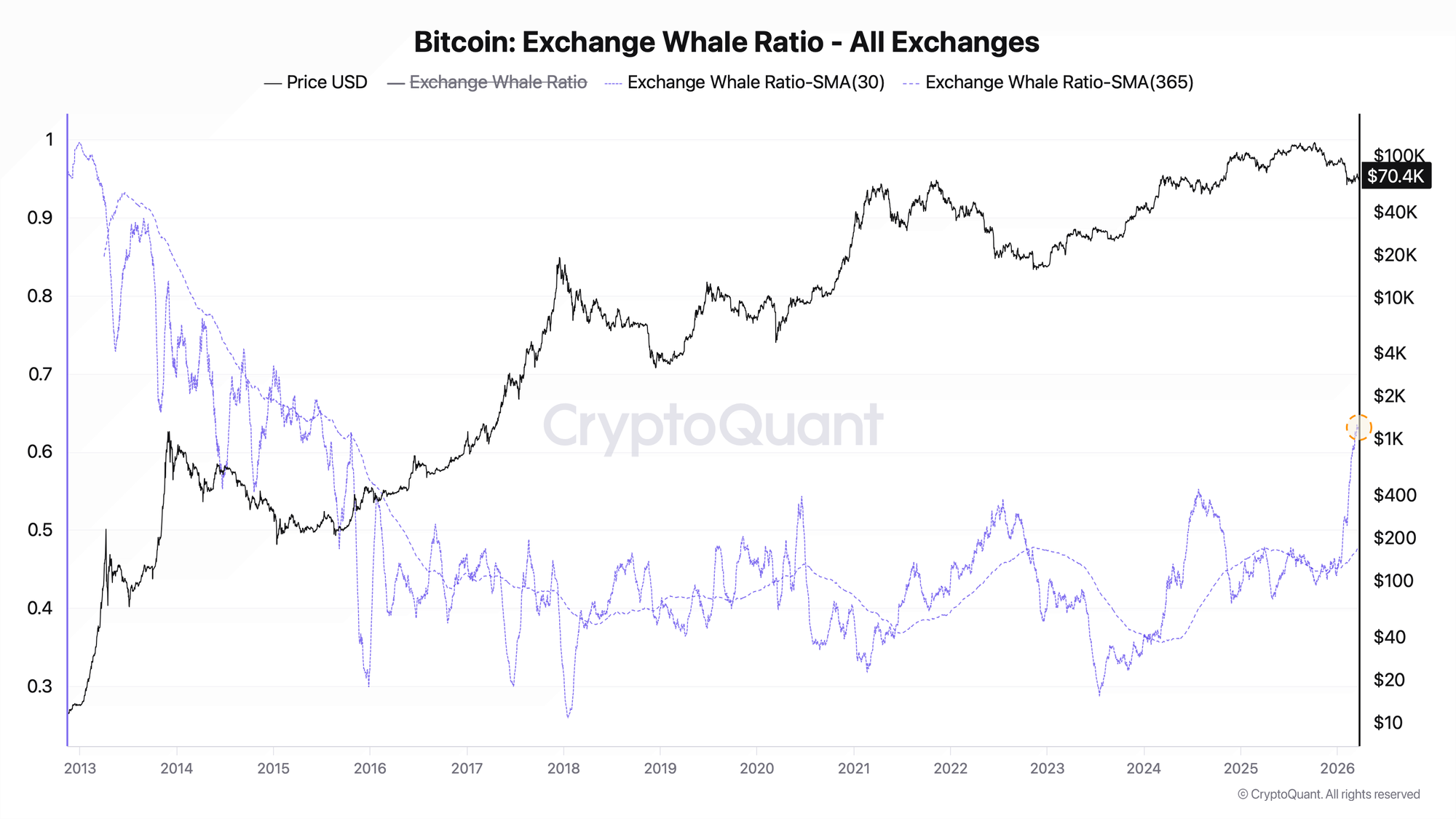
The metric reflects the share of the largest inflows to exchanges and helps gauge how much of the current exchange supply is being shaped specifically by large participants.
After an extended period of relatively moderate values, Exchange Whale Ratio accelerated sharply upward and in March moved notably above its smoothed averages. This means that the role of large transactions in exchange inflow structure has intensified again, and therefore the supply on the sell side has become more concentrated. By itself, such a spike does not guarantee an immediate price decline, but it almost always increases the market's sensitivity to pressure from large holders.
The key takeaway here is that the market is once again facing not ordinary background inflow, but a heavier exchange flow. As long as Whale Ratio holds above its averages, the risk of a new round of distribution remains elevated, and for this pressure to ease, the metric needs to return to a more neutral zone.
Bitcoin: Exchange Inflow - Spent Output Value Bands (%)
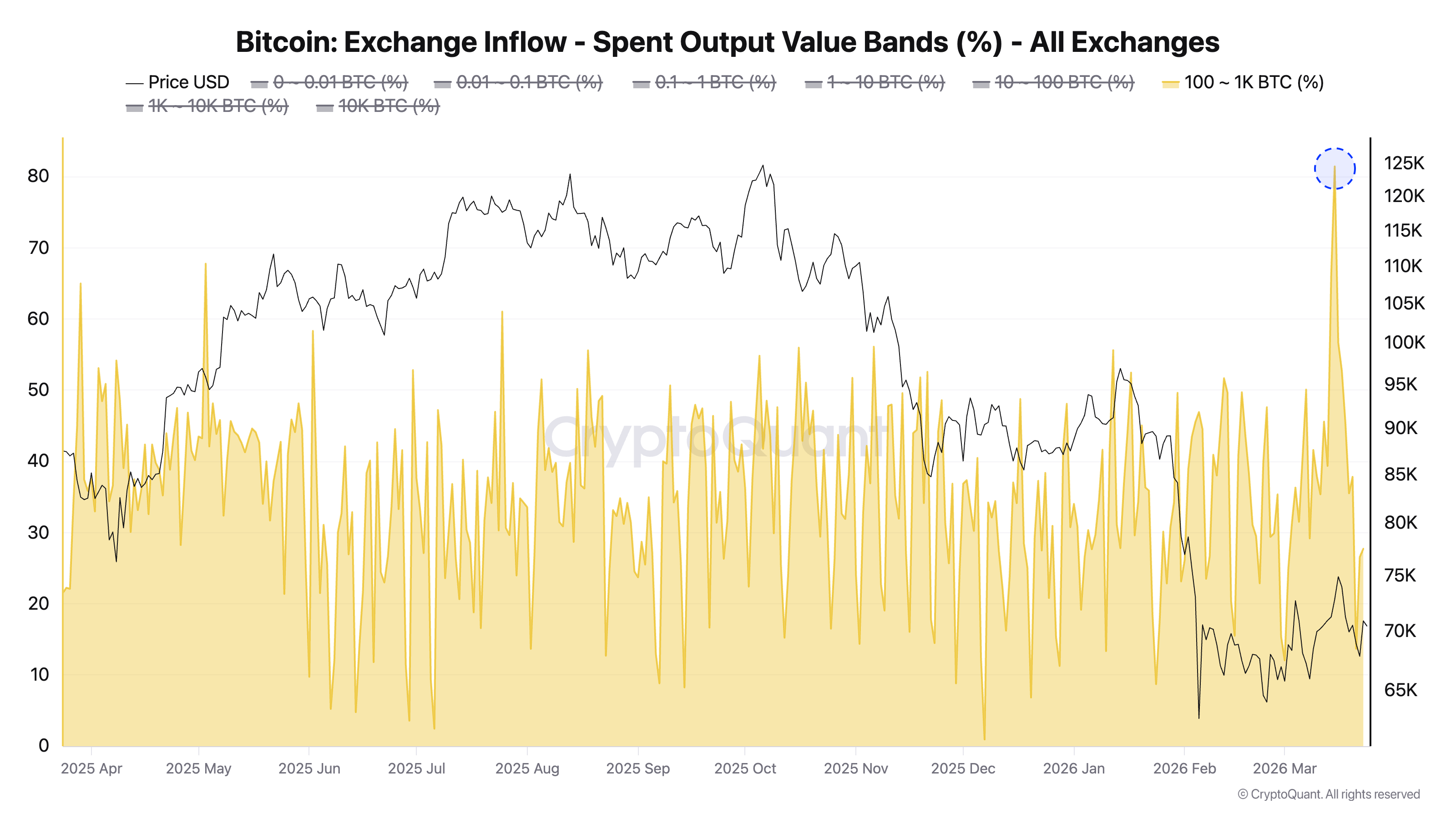
The metric shows which size groups of transfers are shaping the inflow of coins to exchanges, and allows assessing who exactly is currently dominating supply pressure.
In March, the share of the 100-1K BTC range surged sharply to 80%, meaning that nearly all exchange inflow at a given point was formed specifically by large transfers from this segment. This is an important shift because it is not about retail background or minor noise, but about clear dominance of large size in the structure of coins arriving at exchanges. Against this backdrop, the market becomes more sensitive to supply overhang even without the participation of extremely large transfers from the very top range.
For the current regime, this means that pressure is being generated through a specific size group of large participants. If the 100-1K BTC share remains elevated, the market will continue to face distribution risk during any local attempts to rally.
The combination of the two charts is particularly powerful because the first shows rising concentration of large inflows, while the second reveals the source of this pressure by transfer size. In other words, Whale Ratio signals the return of whales to exchanges, and Value Bands specifies that the core of this movement currently lies in the 100-1K BTC range.
Outperform Buy & Hold with a rules-based strategy - Start free. One weekly action, clear triggers, and invalidation levels. No guessing.
FAQ
Why is the rise in Exchange Whale Ratio important right now? Because the metric shows not just an inflow of coins to exchanges, but a strengthening role of the largest transfers in the overall inflow structure. When such a rise occurs against a fragile market balance, pressure from large participants becomes more significant than ordinary background inflow.
What would trigger a weakening of this signal? The most constructive scenario is a normalization of Whale Ratio back closer to its averages and a simultaneous decline in the 100-1K BTC share within the exchange inflow structure. Until that happens, the market remains in a mode of heightened vigilance toward large supply.
CONCLUSIONS
Right now, both exchange signals are saying the same thing: large supply has once again become a notable market factor. This does not equal an automatic downside reversal, but it corresponds to a cautious, closer to risk-off, regime in which any rally must be confirmed by the market's ability to absorb elevated inflow without further expansion of whale activity. The main trigger for improvement - a decline in Whale Ratio and cooling of the 100-1K BTC share, and the main risk - these signals becoming entrenched as a new distribution regime rather than a one-off spike.