


Bitcoin rose 22% in eight days, climbing from $63K to $77K. During this period, the share of STH supply in profit increased to 74%, while the indicator tracking STH flows to exchanges moved from negative to positive territory.
Short-term holders quickly recovered from their drawdown, but their return to profit also increased the volume of coins sent to exchanges.
TL;DR
The share of short-term holder supply in profit rose from 26.1% to 74.9%. At the same time, the average STH flow to exchanges turned positive, increasing the risk of selling pressure from STHs.
Bitcoin STH Supply in Profit (%)
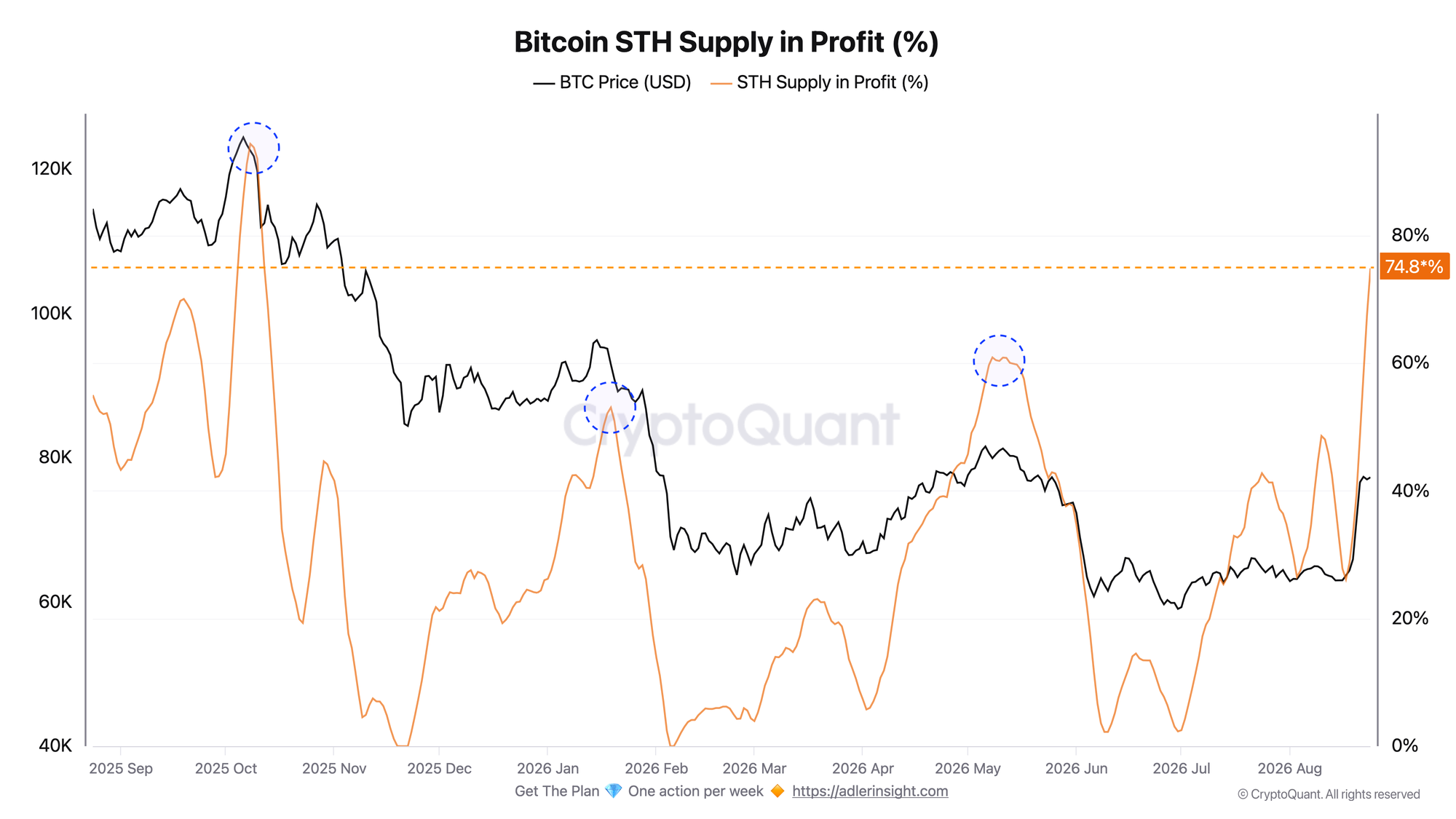
The metric shows the 7-day average percentage of short-term holder supply currently in profit.
On August 17, the metric stood at 26.1%, meaning that nearly three-quarters of STH supply was at a loss. After BTC rose to $77.3K, the share in profit climbed to 74.9%. Most coins held by the short-term cohort are now above their acquisition price again.
A move back below 50% would mean that the cohort's recovery in profitability has failed to hold. A move toward 90%+ would increase the risk of profit-taking.
Bitcoin STH Net Profit Loss to Exchanges
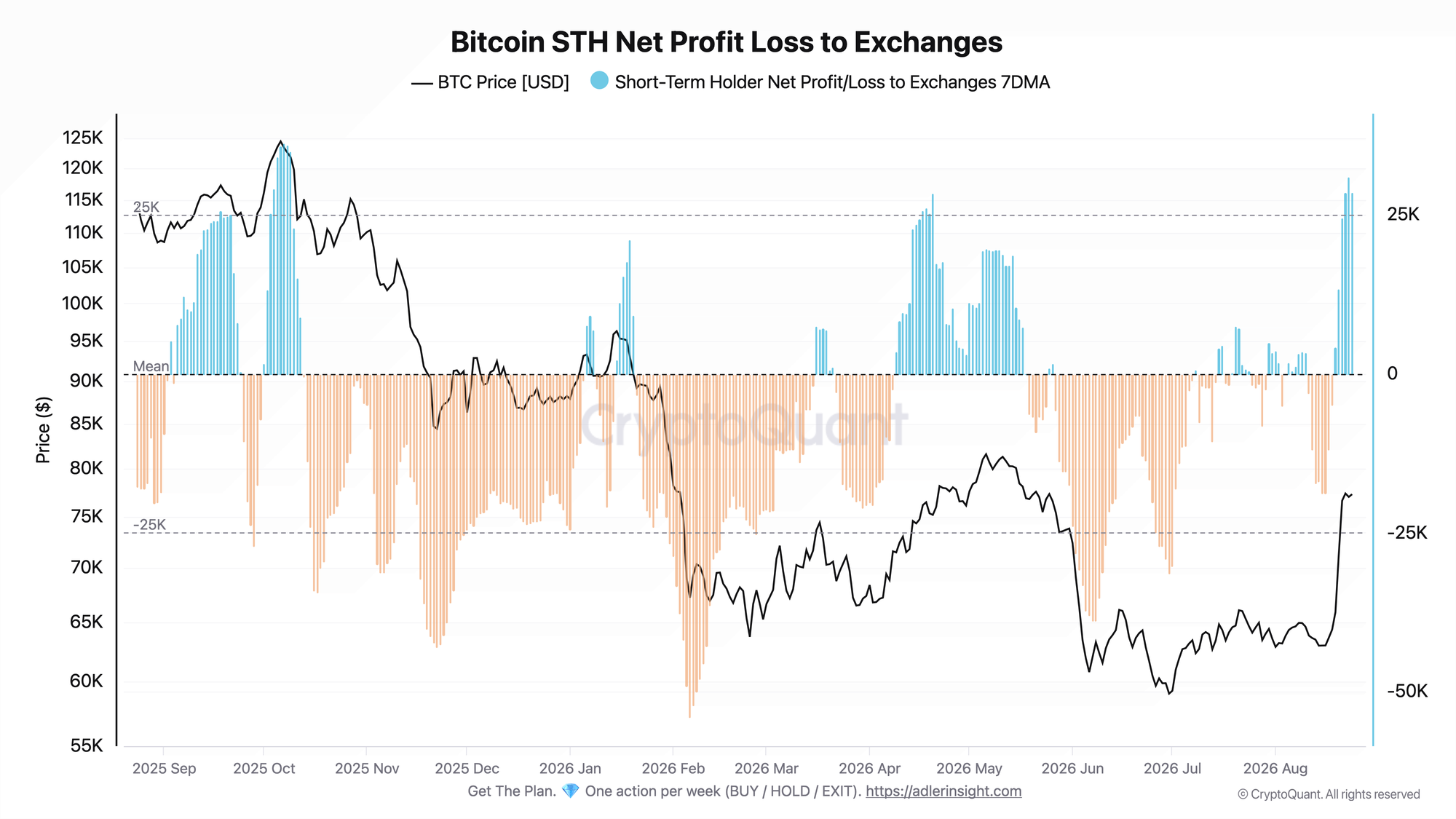
The metric stood at -18.7K BTC on August 16 and -11.9K BTC on August 17. By August 24, it had moved into positive territory, reaching +28.6K BTC and crossing the +25K threshold. This means that STH inflows to exchanges increased as the short-term cohort's average realized return moved back into positive territory.
Sending coins to exchanges creates sell-side pressure from short-term holders. If the metric holds above +25K while price momentum slows, the risk of distribution will increase. A return toward zero while the price holds would indicate lower potential pressure.
Together, the charts show that the amount of profitable STH supply has risen sharply, while exchange inflows from this cohort have accelerated.
One decision per week. A defined exposure cap. Weekly Engine replaces fear, FOMO, and guesswork with a rules-based Bitcoin strategy you can follow.
FAQ
What does the simultaneous increase in the share of supply in profit and exchange inflows mean? Most short-term holders are back in profit, while the volume of coins sent to exchanges is increasing. This raises the risk of selling.
What level would signal deterioration? If the flow holds above +25K BTC while the share in profit moves toward 90% and price momentum slows, the risk of local overheating will increase. A decline in the flow toward zero while the share in profit remains above 50% would indicate a healthier consolidation.
CONCLUSIONS
The position of short-term holders has improved significantly, with the share of supply in profit rising to 74.9%. At the same time, the exchange flow indicator climbed to +28.6K BTC, increasing potential sell-side pressure.
The positive scenario requires exchange flows to cool toward zero while the share in profit remains above 50%. The main risk will emerge if the flow holds above +25K BTC, the share in profit approaches 90%, and price momentum begins to weaken.
Live Charts
Explore the metrics behind this brief with live, auto-updating charts:
Supply in Profit - Share of circulating supply in profit as a cycle-phase and euphoria gauge.
STH-SOPR - Short-term holder profit/loss behavior around the 1.0 breakeven threshold.
Exchange Netflow - Net BTC moving to and from exchanges across positive and negative flow regimes.
Supply in Loss - Share of supply held at a loss to flag stress and capitulation zones.
Holder Behavior - All holder profitability and supply-cohort charts in one view.