


🎧 Morning Brief #161 - audio debate on today’s market setup
Bitcoin is trading around $80.3K against a mixed picture in spot flows: over the past few days, net inflows to exchanges totaled +8,512 BTC, yet the price not only held but continued to rise. Today's two charts tell the same story from different angles: a local supply overhang has formed on exchanges, but there is no selling pressure yet.
TL;DR
Exchange reserves grew over the week, but coins did not move into selling - the market is absorbing current supply without price damage. The overhang is there, the pressure is not. This is not a bullish signal, but it is not capitulation either.
Bitcoin Exchange Netflow
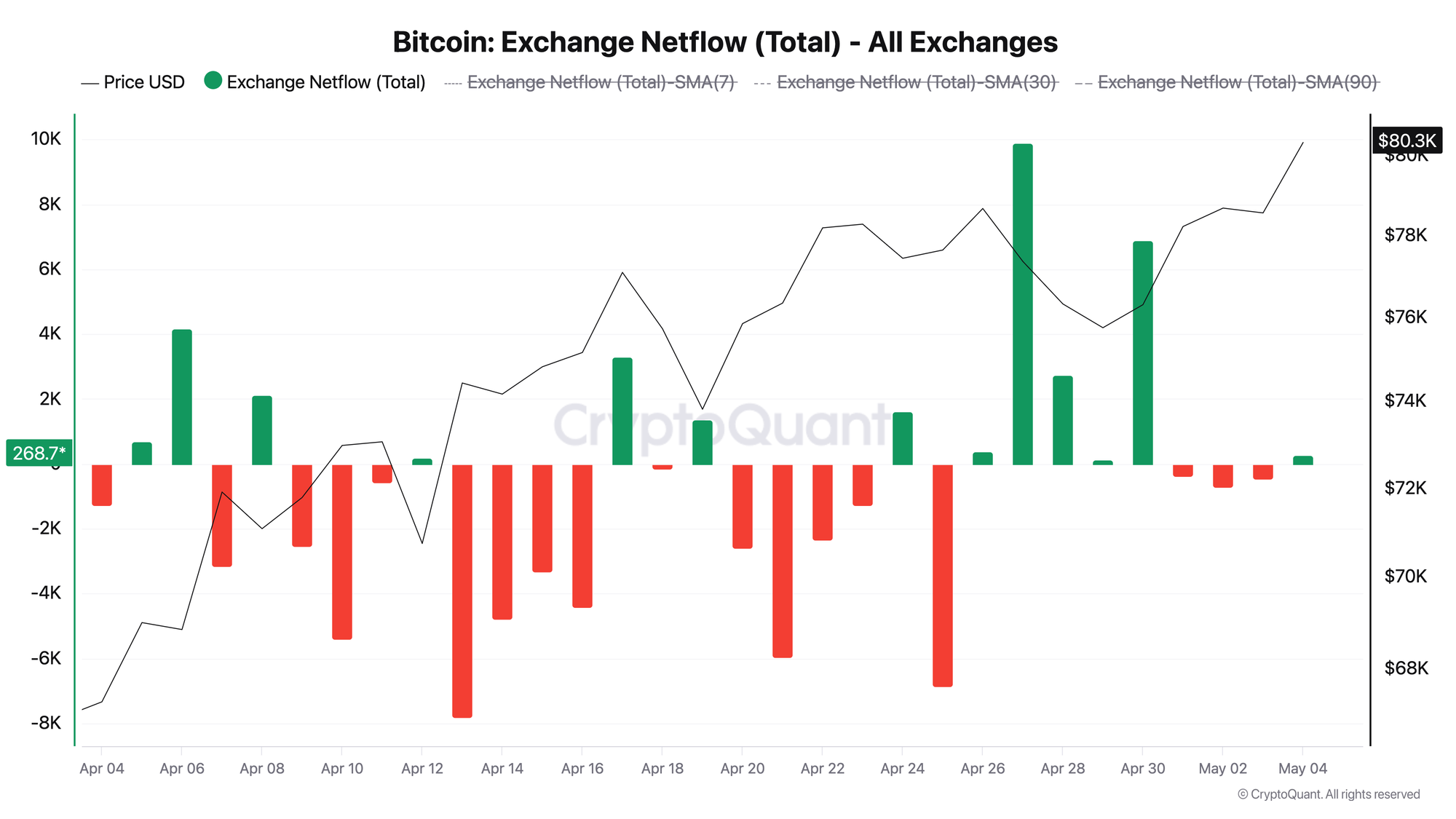
Netflow reflects the difference between BTC inflows to exchanges and outflows from them. Positive values indicate potential selling pressure, negative values - a sign of accumulation.
Over the past few days, net inflow totaled +8,512 BTC. The bulk came from two spikes: +9,905 BTC on April 27 and +6,903 BTC on April 30. Over the last three days, May 1-3, minimal outflows began to appear, and the current reading of +269 BTC remains effectively neutral. SMA(7) stays in positive territory, while SMA(30) and SMA(90) remain near zero. This confirms that the weekly impulse still looks like a local spike rather than a regime change.
Key takeaway: inflows occurred, but have not translated into selling so far. During the most aggressive inflow period the price rose - meaning the market was able to absorb supply without immediate price damage. In essence, holders moved coins to exchanges but are not selling aggressively yet.
Bitcoin Exchange Reserve
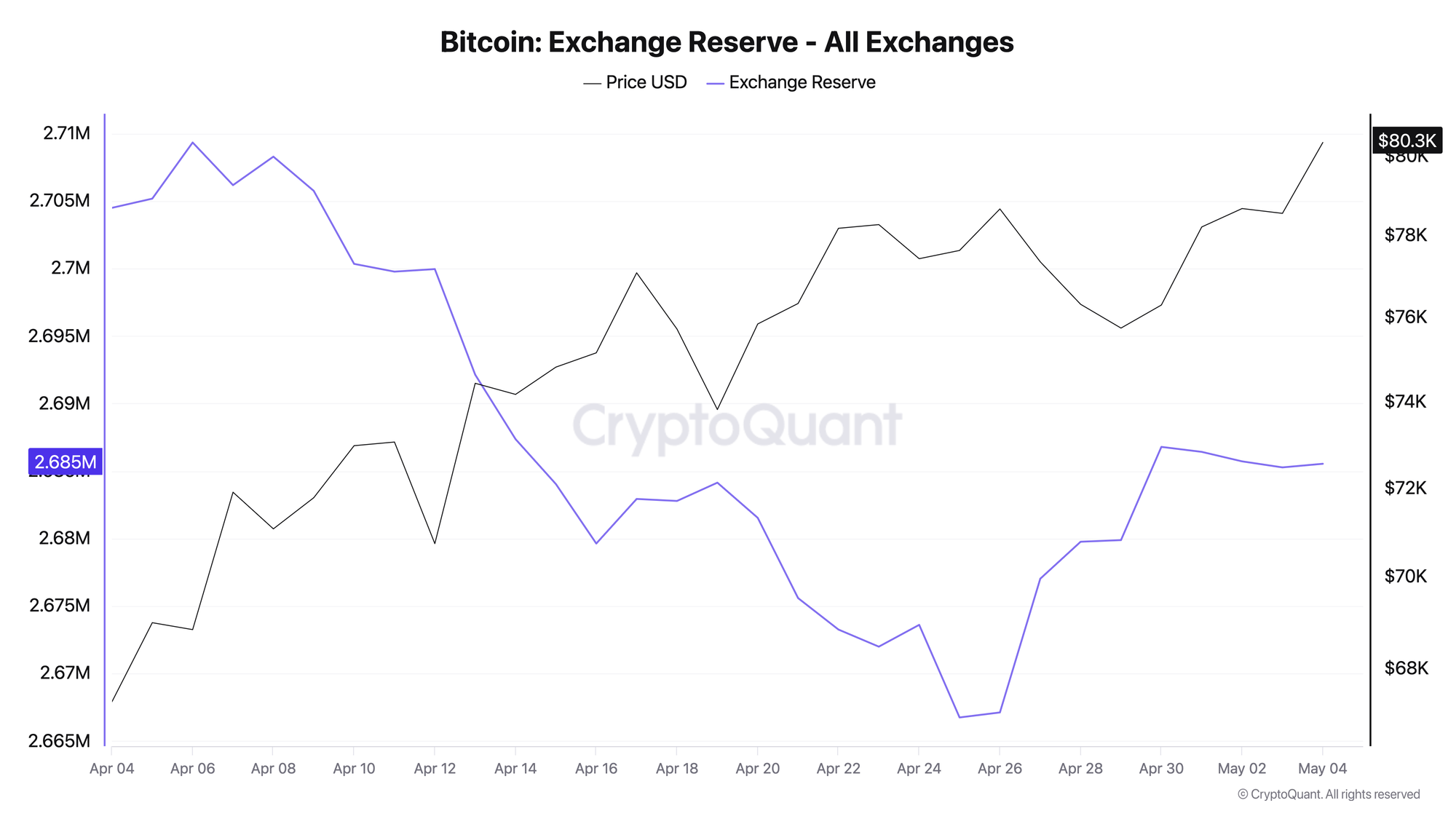
Exchange Reserve is the total volume of BTC held on exchanges. A rising reserve means an increase in available supply.
As of May 4, total reserve stands at 2,685,541 BTC - +5,773 BTC above the level from a week ago (2,679,768 BTC on April 28). The local weekly peak was recorded on April 30 at 2,686,791 BTC, after which the reserve began a modest decline.
Coins are on exchanges, but they are not being sold yet. This is a dry powder structure: supply has been deposited on platforms, but its conversion into actual selling has not been confirmed. The risk is that this overhang can transition quickly into real selling pressure if the market stops absorbing new inflows. A further decline in Reserve alongside continued price growth would confirm a healthier market structure.
LINK
Together, the two charts show that a local supply overhang has formed on exchanges. Netflow captures the fact of recent inflows, while Reserve confirms that a portion of those coins remains on exchanges. But for now this remains potential supply, not confirmed selling pressure.
Outperform Buy & Hold with a rules-based strategy - Start free. One weekly action, clear triggers, and invalidation levels. No guessing.
FAQ
Why is the price rising if BTC is flowing into exchanges? Inflows to exchanges create potential supply, but do not by themselves mean selling. If buyer demand exceeds the volume of coins actually offered for sale, prices can rise even with positive Netflow. That is exactly what is happening right now.
Under what conditions would the narrative turn bearish? A bearish scenario would begin to confirm if inflows stopped being absorbed by the market: Exchange Reserve continues to rise steadily, Netflow stays in positive territory across multiple days, and the price simultaneously loses upward momentum and starts to weaken. In that case, accumulated supply would begin transitioning from a potential overhang into real selling pressure.
CONCLUSIONS
The combined picture from Netflow and Reserve remains two-sided. Exchanges received +8,512 BTC over the past few days, and the reserve grew by +5,773 BTC - creating the risk of potential selling pressure. But the market has not acted on that risk yet: price climbed to $80.3K, and after the reserve peak on April 30 a modest decline began. The supply overhang is formed and remains above the market, but selling pressure has not materialized. The key trigger for deterioration - the last three days of outflows reversing back into inflows against a backdrop of price weakness. The key risk - rapid realization of this dry powder.