


🎧 Morning Brief #135 - audio debate on today’s market setup
Long-term holders have continued to build positions since January, but since late February part of the cohort has been realizing losses on sales. These two charts together show a transitional regime: accumulation is not yet broken, but the pressure of forced selling is already visible in SOPR.
TL;DR
LTH are simultaneously continuing to accumulate and selling a portion of coins at a loss. This rare combination typically emerges in transitional or stressed market phases: the cohort has not yet shifted to full distribution, but internal pressure is already building.
BTC: Long-Term Holders (LTH) SOPR High or Low Profit
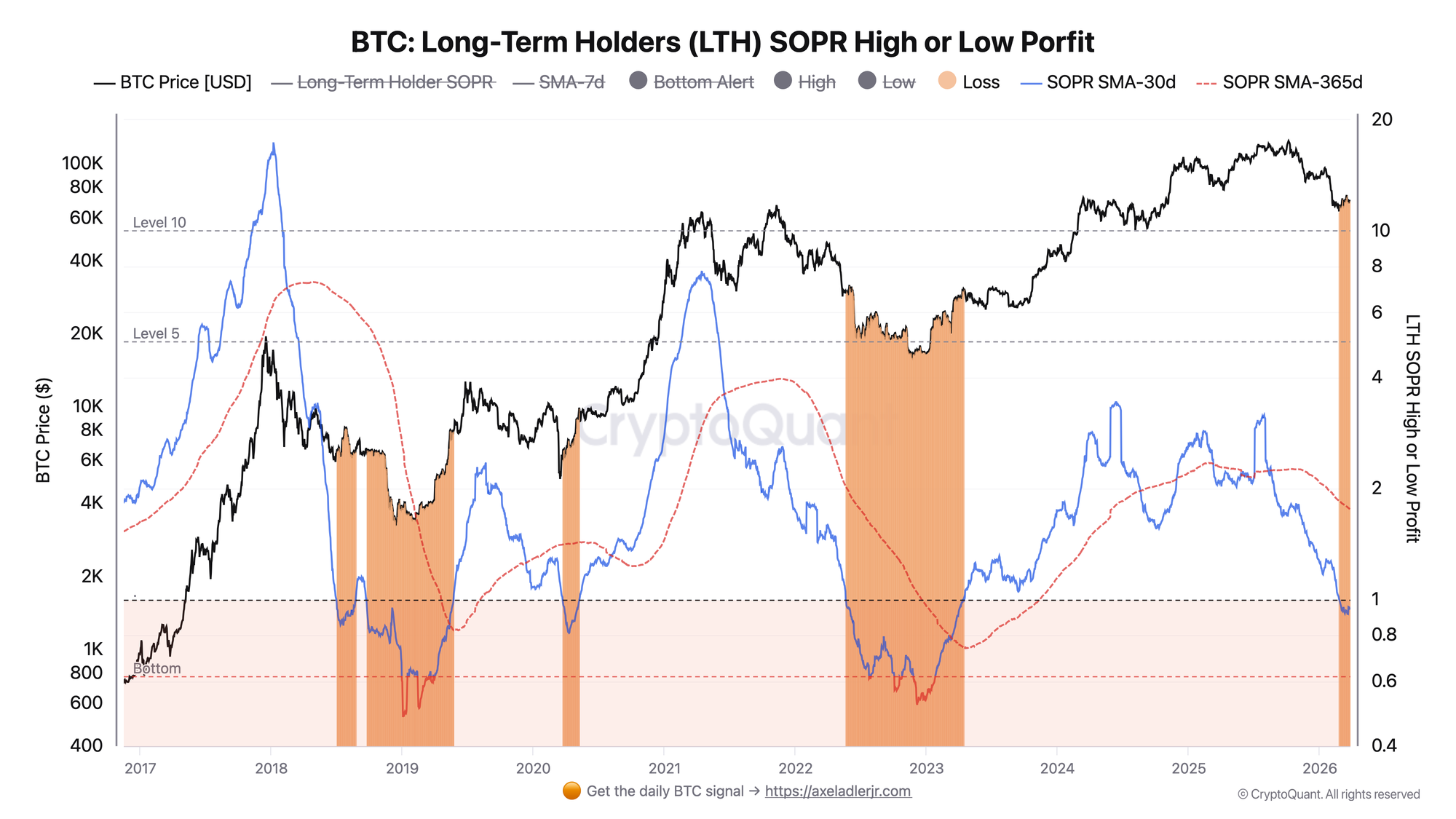
LTH SOPR dropped below the 1.0 level in late February and has remained in loss territory since. The SMA-30d is currently around 0.94, meaning LTH are on average realizing losses on sales. The Loss zone on the chart is now active - in past cycles such regimes appeared during prolonged stress periods, including the 2018-2019 bear market, the COVID breakdown of 2020, and the capitulation phase of 2022-2023.
The key distinction in the current episode is that it is developing at a significantly higher price level than in previous historical LTH loss phases. This points not to broad cohort capitulation, but to localized pressure from holders whose cost basis was established closer to the 2025 peak. As long as SMA-30d remains below 1.0, the loss-selling regime persists and acts as a structural risk factor.
BTC: Long-Term Holder 30 day Net Position Change
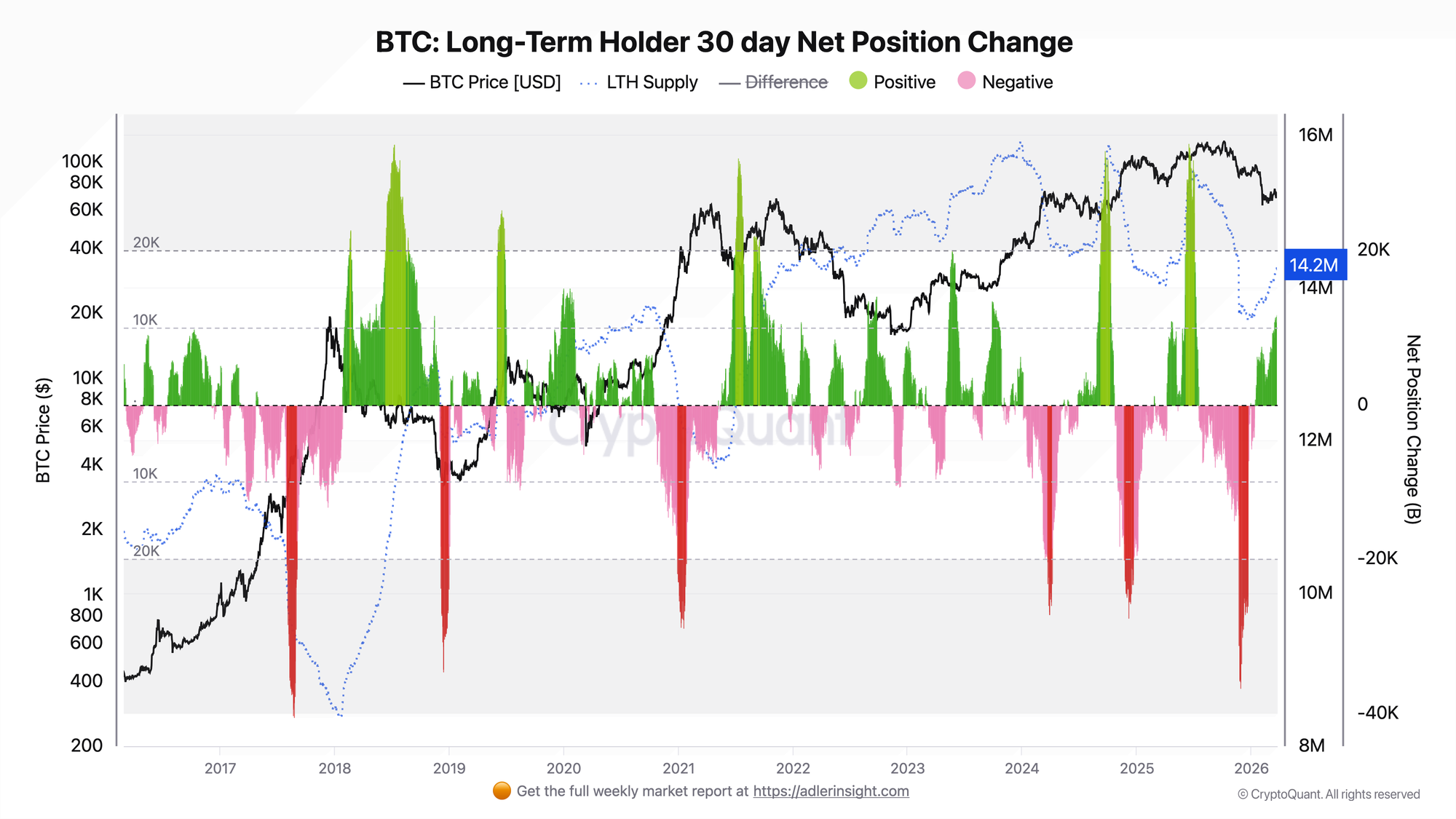
Since January 2026, the 30-day net position change for LTH has remained positive: green bars dominate, and the total LTH supply on the right axis holds around 14.2M BTC. This means the cohort has not moved to selling overall and continues to absorb supply even amid the price correction.
This is precisely why the SOPR signal is especially important right now. At the cohort level, accumulation is still intact - but the portion of LTH that is exiting positions is doing so at a loss. This does not resemble the broad capitulation typical of prolonged bear market phases.
Connection: the two charts together reveal a divergence within the LTH cohort. The overall position is still growing, but part of the cohort is already selling at a loss. As long as accumulation holds, this signal looks like a warning rather than confirmed capitulation. But if Net Position Change begins moving into negative territory while SOPR remains below 1.0, the risk of a transition to full distribution will rise sharply.
👀 Outperform Buy & Hold with a rules-based strategy - Start free. One weekly action, clear triggers and invalidation levels. No guessing.
FAQ
What does SOPR below 1.0 mean for long-term holders? When LTH SOPR drops below 1.0, it means that coins moved by long-term holders are on average being realized below their acquisition price. For this cohort, this is a rare signal that typically appears during periods of market stress and weakening conviction.
Under what conditions would the signal turn more positive? The key trigger is a sustained return of SOPR SMA-30d above 1.0. This would indicate that LTH sales are again being realized at a profit and that the pressure of forced selling is easing. Additional confirmation would be the continued positive Net Position Change - meaning accumulation at the cohort level is being maintained.
CONCLUSIONS
LTH remain in an accumulation regime, but notable pressure from loss-realizing sellers has emerged within the cohort. This does not yet look like full capitulation: the overall position continues to grow, and the scale of selling remains well below the extremes of 2018 and 2022. However, the fact that SOPR is below 1.0 shows that the resilience of the accumulation regime is weakening. For the picture to improve, SMA-30d needs to return above 1.0 while Net Position Change stays positive. For the picture to worsen, one condition is sufficient: if accumulation stops and the LTH net position turns negative, the market will quickly shift from a regime of internal stress to one of real distribution.