


🎧 Morning Brief #189 - audio debate on today’s market setup
Three key metrics of miner economics are simultaneously pointing to mounting pressure. The Puell Multiple 30DMA has fallen to 0.74, the Price-to-Miner-Revenue Multiple has retraced from peak levels of 160 to 80, and the price has declined 21% from the latest Difficulty Bottom. Today we break down how similar the current situation is to the bottoms of 2018 and 2022, and what the market still lacks for a true capitulation.
TL;DR
Miner metrics have entered a stress zone comparable to post-halving drawdowns, but the market has not yet reached a full-scale capitulation on the scale of 2018 and 2022. The key question is whether the Puell 30DMA will hold above 0.50, or whether the market will shift into survival mode.
Bitcoin The Puell Multiple
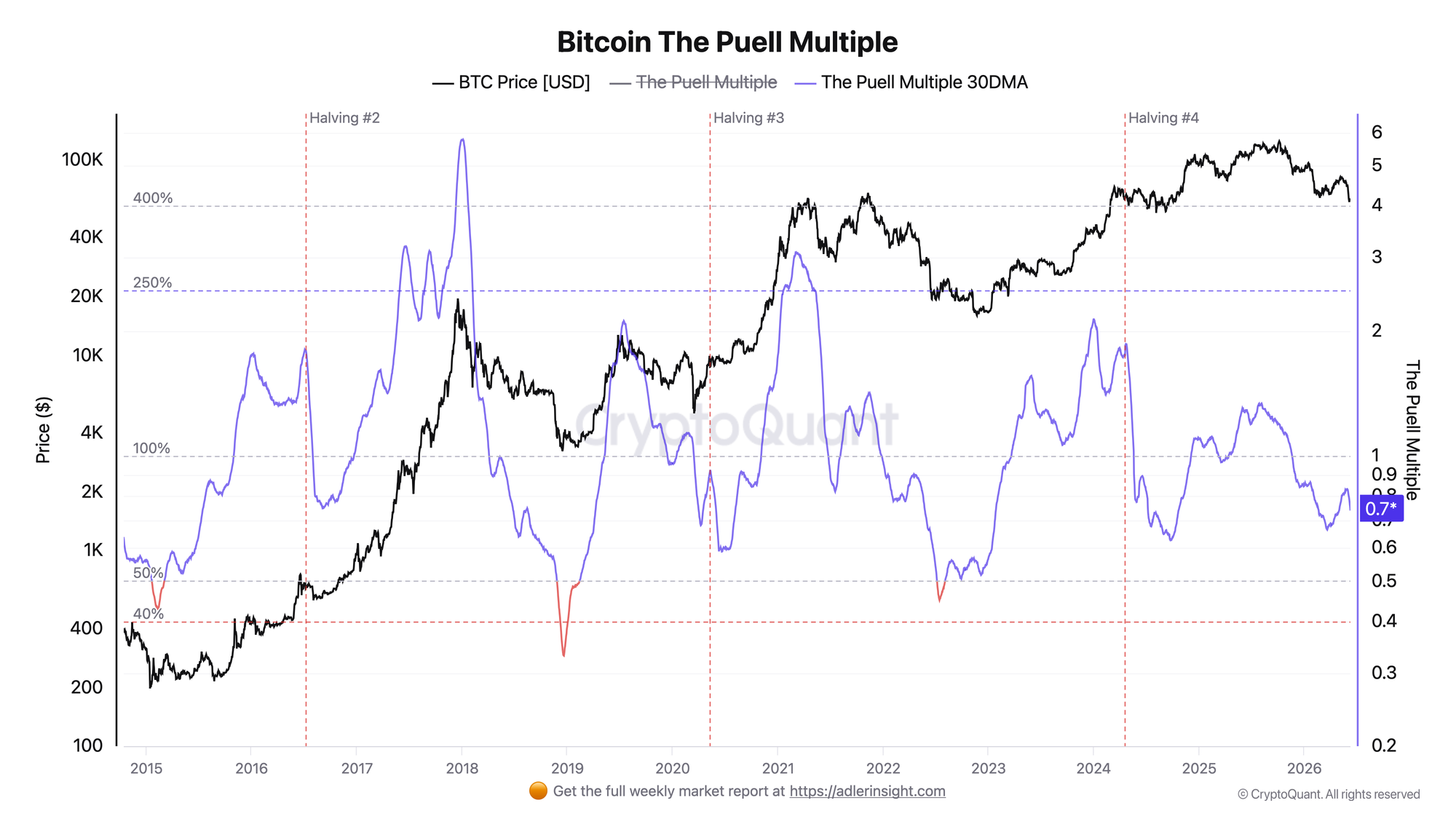
The Puell Multiple reflects the ratio of miners' daily revenue to its 365-day average. Values below 1.0 mean current revenue is below the annual norm. The deeper the drawdown, the stronger the economic pressure on operators.
The Puell 30DMA fell from 0.83 at the end of May to 0.74 on June 10 - an 11% decline in ten days. The raw Puell Multiple dropped even lower, to 0.58, pointing to a sharp compression in daily revenue. For comparison, at the cycle peak in July 2025, when BTC was trading above $120K, the Puell 30DMA stood at 1.33. The current reading of 0.74 matches the zone where the indicator traded in July-August 2024, with BTC in the $55-68K range, immediately before and after the halving. However, at the 2022 bottom, the 30DMA fell to 0.45, and in December 2018 it dropped to 0.33. The current 0.74 is stress, but not yet capitulation.
The direction of the trend now matters more than the absolute level: the 30DMA has been declining every day for the past two weeks. If this pace continues, the 0.50 zone - the threshold at which mass equipment shutdowns began in 2022 - could be reached by the end of June. A reversal higher in the Puell 30DMA would be the first sign that pressure is easing.
Bitcoin Price-to-Miner-Revenue Multiple
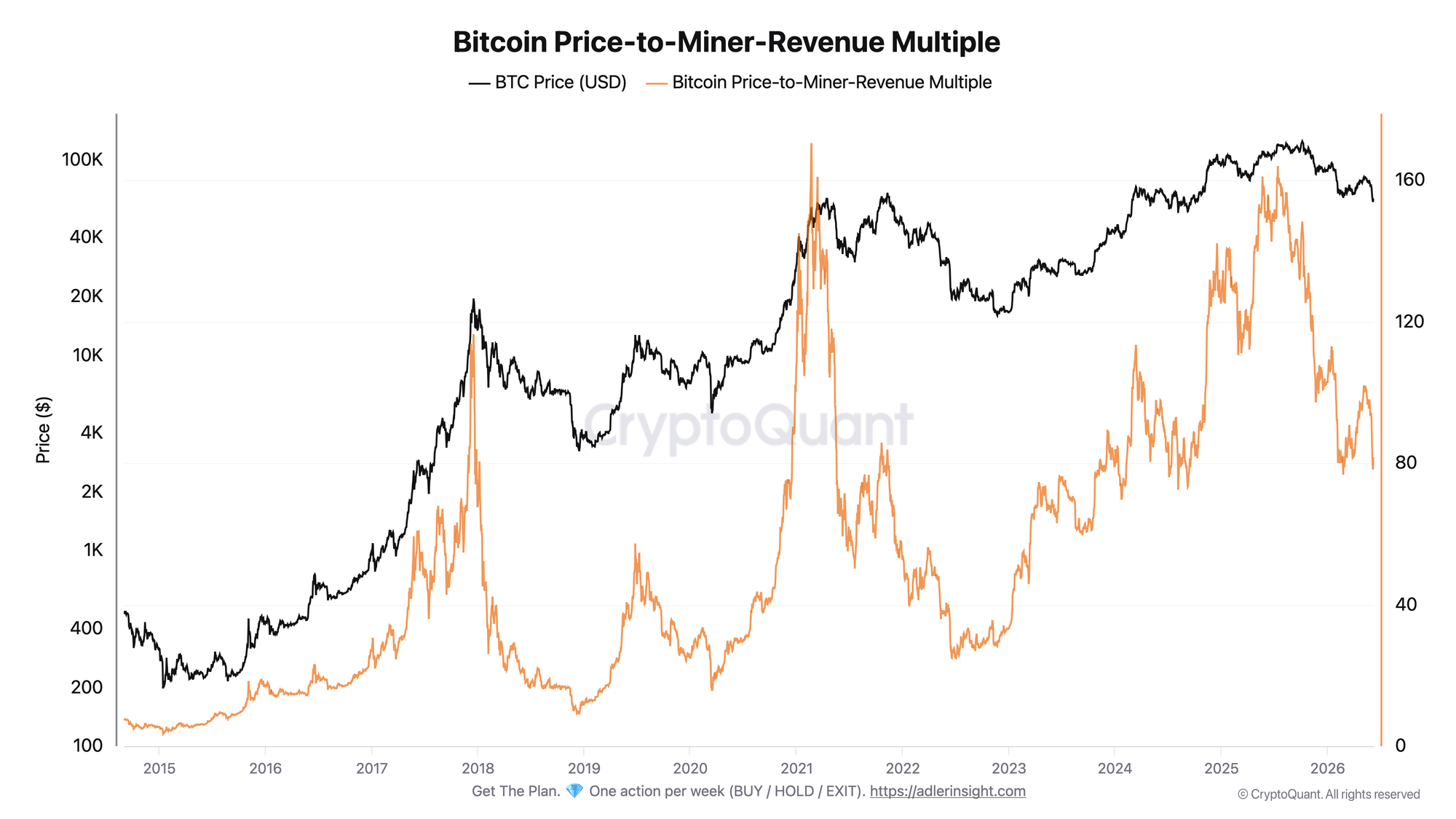
The Price-to-Miner-Revenue Multiple is the ratio of the BTC price to miners' rolling annual revenue per coin. High values mean the market is valuing bitcoin far above the income earned by its "producers." Lower values, by contrast, mean the price is compressing closer to cost.
As of June 10, the multiple stands at 80. That is exactly half of the peak reading of 160, recorded in July 2025 and February 2021. But the context matters: at the 2022 bottom, the metric fell to 33, and in February 2019 it dropped to 15. The current level of 80 matches the November 2021 range, when BTC was around $57K and the market was still in a bullish phase but had already passed peak euphoria. Since the end of May, the multiple has been steadily declining alongside the fall in BTC.
The 80 level is a normalization zone, where the speculative premium over miner revenue is shrinking but has not yet moved into undervaluation territory. A deep-bottom signal would require a decline into the 40-50 range, and that would require either a further drop in price or a prolonged period of weak miner revenues. For now, the metric points more to a correction than to a structural breakdown.
Bitcoin Miner Capitulation
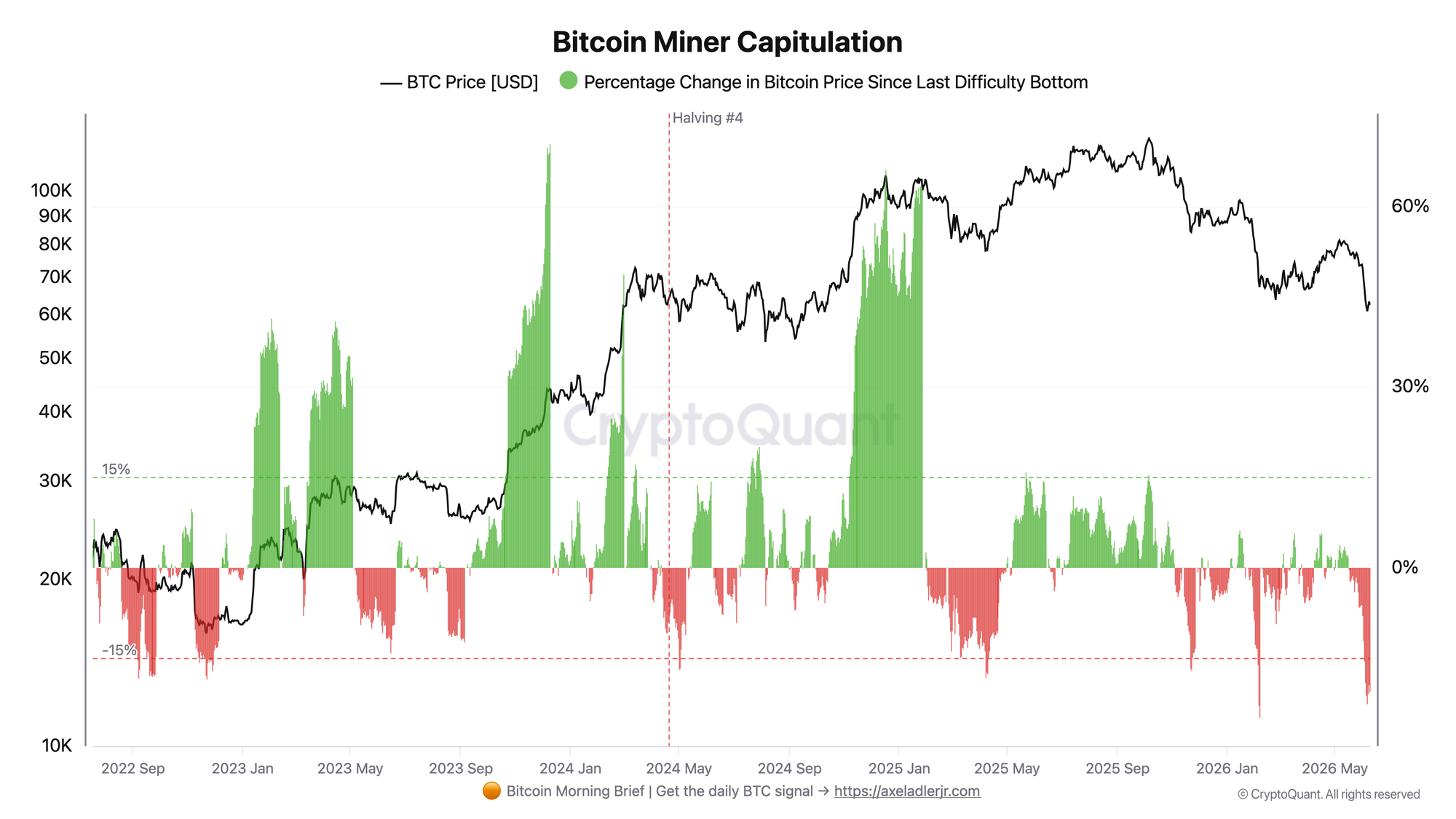
Miner Capitulation measures the percentage change in the BTC price since the last drop in network difficulty, that is, the Difficulty Bottom. Negative readings mean the price fell after the network had already gone through an adjustment. This indicates that miners are operating under harsher conditions relative to the latest difficulty reset.
As of June 9, the drawdown stands at -21%. Just a week earlier, on June 1, the metric was at -8%, and at the end of May it was hovering around zero. Pressure has clearly intensified. For context, the worst reading in 2022 reached -39% in January, with BTC around $35K, while in 2018-2019 the drawdowns from the Difficulty Bottom were much milder - in the -5-6% range. The current -21% already represents serious pressure, comparable to the red zones on the chart, but it is still about twice as mild as the 2022 extreme.
The -15% threshold marked on the chart has already been broken. If the price continues to fall without a subsequent upward difficulty adjustment, the drawdown could deepen to -30%, and historically that zone is where forced selling and equipment shutdowns tended to occur. A rise in difficulty or a return in price above $70K, by contrast, would push the metric back into neutral territory.
All three metrics form a consistent picture. Puell confirms revenue compression, Price-to-Miner-Revenue shows the speculative premium shrinking, and Miner Capitulation indicates that pressure has already entered the red zone. But none of the metrics has yet reached the levels characteristic of the final phase of the cyclical lows of 2018 and 2022.
FAQ
Is the current situation already miner capitulation? No. Capitulation in the strict sense is a scenario in which the Puell 30DMA falls below 0.50, the P2MR compresses toward 30-40, and the drawdown from the Difficulty Bottom exceeds -30%. Right now, all three metrics are in the stress zone, but not at extremes. For comparison, in 2022 Puell fell to 0.45, P2MR to 33, and the drawdown to -39%. The current readings are roughly half as severe.
What would have to happen for the pressure to move into a capitulation phase? It would require a further decline in price without a new downward difficulty adjustment. If BTC falls below $55K at the current hashrate, the Puell 30DMA could drop toward 0.50, and the drawdown from the Difficulty Bottom could approach -30%. Historically, that was the zone where mass ASIC shutdowns and forced BTC selling by miners began, which paradoxically helped form the bottom.
CONCLUSIONS
Three miner metrics have simultaneously entered the stress zone: the Puell 30DMA has fallen to 0.74 and continues to decline steadily, the Price-to-Miner-Revenue Multiple has been cut in half from its peak to 80, and the price has dropped 21% from the latest Difficulty Bottom. The pressure is consistent, but capitulation is still far off - all the indicators are sitting roughly halfway between neutral readings and the extremes of 2018 and 2022. The current regime is risk-off with rising stress. The main trigger for further deterioration is BTC falling below $55K without a difficulty adjustment, which would push Puell toward 0.50 and trigger a cycle of forced selling. The main reversal trigger is a downward difficulty reset or a return in price above $70K, which would bring Puell back into the 0.85+ zone and reset Miner Capitulation.
Live Charts
Explore the metrics behind this brief with live, auto-updating charts:
Puell Multiple — Miner revenue stress and expansion relative to the 365-day average.
MVRV Ratio — Market value vs realized value to gauge how far price sits above aggregate cost basis.
Realized Price — Aggregate on-chain cost basis as a floor reference during miner stress periods.
NUPL — Net unrealized profit/loss to cross-check whether broader holders confirm miner-side pressure.