


🎧 Morning Brief #134 - audio debate on today’s market setup
Against the backdrop of volatile dynamics in recent weeks, two signals form a coherent picture: short-term holders continue to realize losses on exchanges, while institutional demand via ETFs is strengthening noticeably.
TL;DR
Over the past 30 days, ETF funds accumulated nearly +63,000 BTC with net inflows of $11.3B, while short-term holders consistently realize losses on exchanges. Institutional buying currently outweighs retail selling pressure and provides price support.
Bitcoin ETF Tracker: Daily Flows & Cumulative Holdings
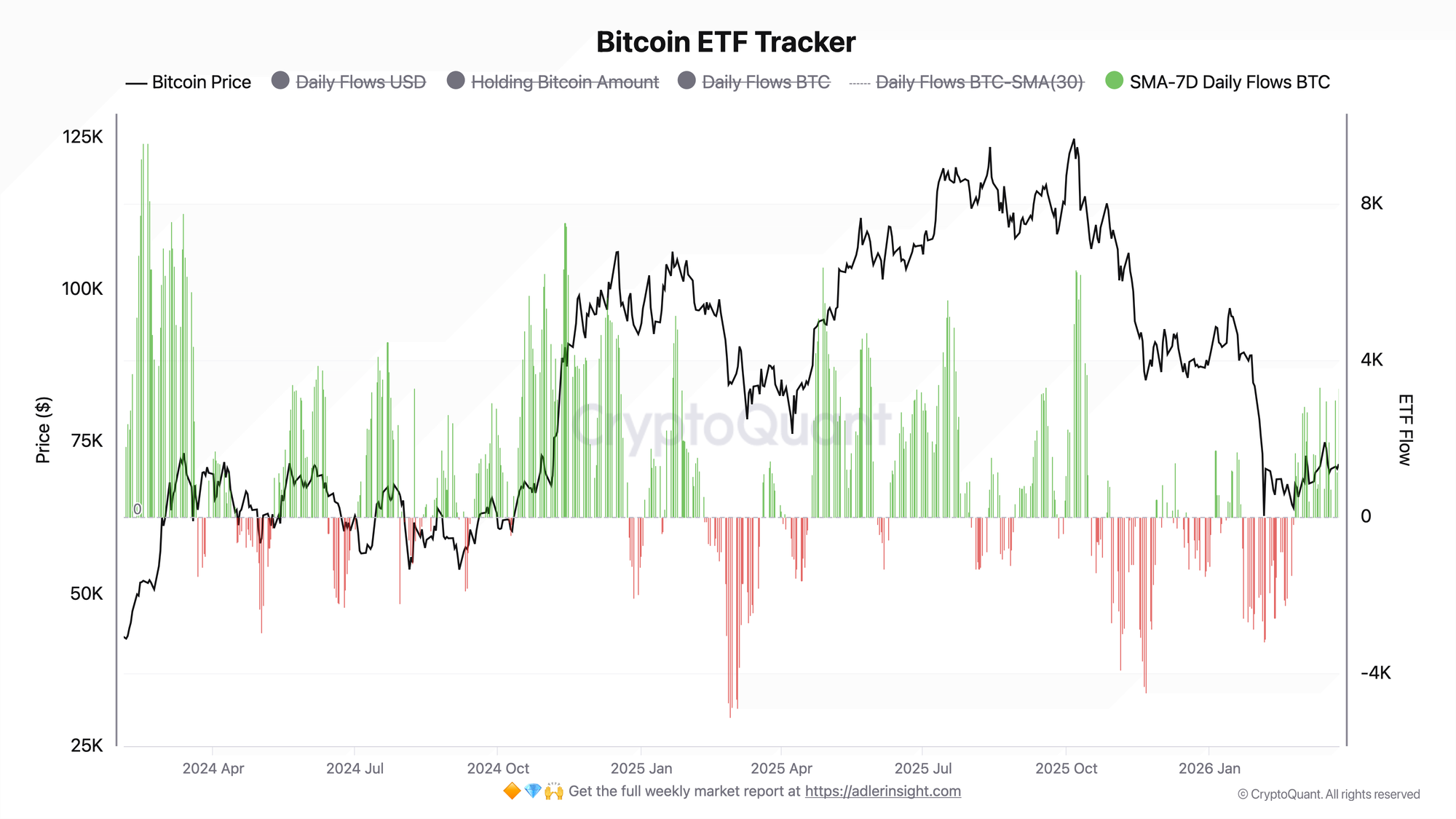
The metric reflects daily net flows into Bitcoin ETFs in USD and BTC.
From February 24 to March 25, ETF funds received net inflows of $11.3B, or +62,986 BTC, bringing cumulative holdings to 1,326,874 BTC. The dynamics remained uneven: 13 positive trading days versus 9 negative, with the largest single-day outflow recorded on March 18 at -$4.53B. The key signal of recent days is the acceleration of inflows: the 7-day SMA of flows stands at +3,288 BTC per day versus +1,256 BTC for the 30-day SMA. This means the current weekly buying pace is approximately 2.6x higher than the monthly average.
Over the same month, price rose from $64,100 to $71,307, showing that the market is broadly absorbing episodic outflows and maintaining support from institutional demand. For the momentum to continue, it is important that the short-term inflow pace remains above the medium-term average for several more consecutive trading days. The primary risk is a return to a series of negative days without a new macro or market catalyst.
Bitcoin Short-Term Holder P&L to Exchanges Sum 24H
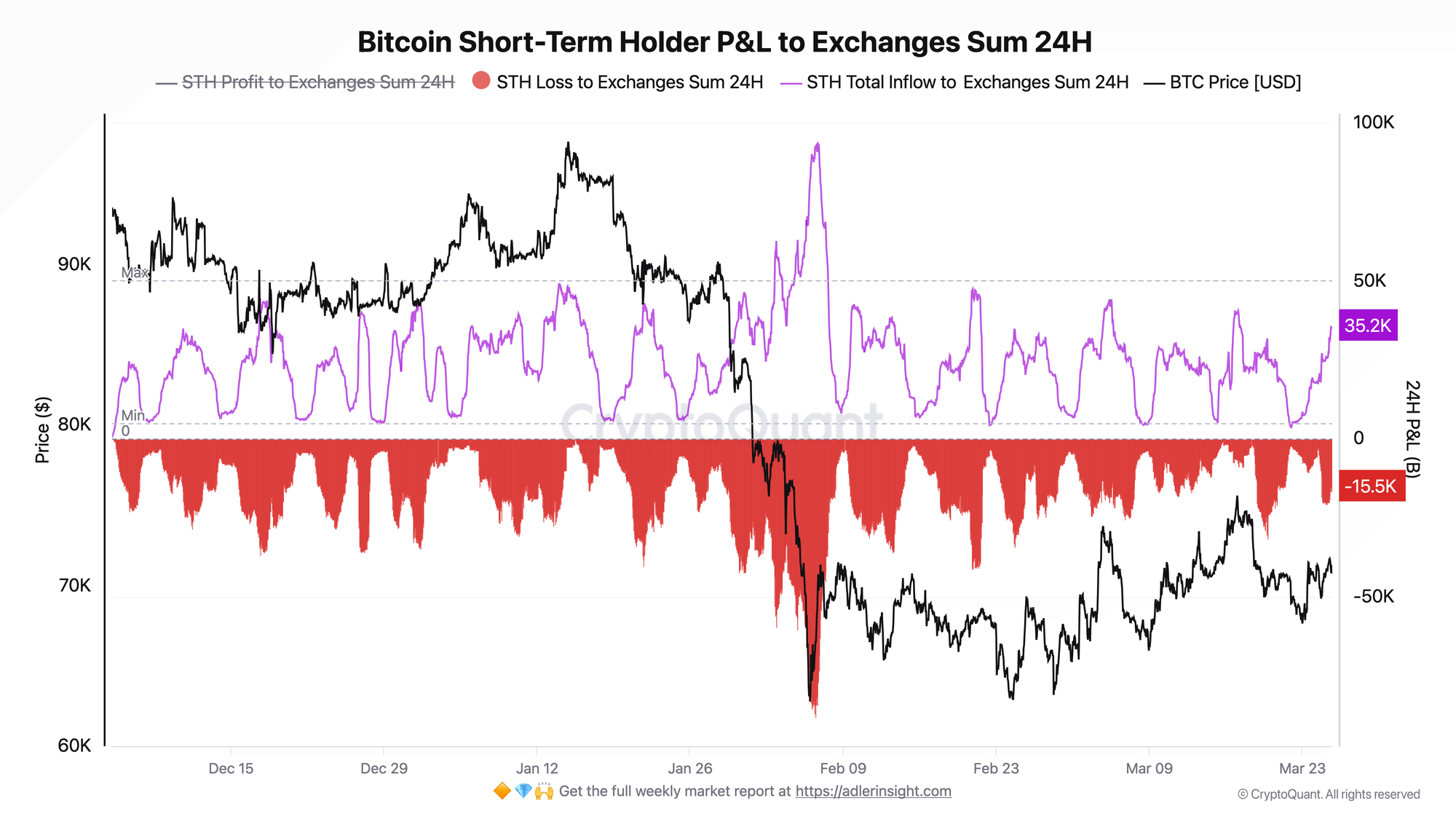
The metric shows how many BTC short-term holders send to exchanges at a loss, as well as the total STH inflow to exchanges over 24 hours.
The chart shows a clear regime shift following the local price peak: from that point, loss-realizing STH sales began to structurally dominate and have been unable to recover above the neutral zone. The current volume of loss-side flow stands at -15.5K BTC per 24 hours, consistent with a sustained stress regime for short-term holders. The total STH inflow to exchanges stands at 35.2K BTC per 24 hours. This points to continued seller activity, though without the extreme spike typically associated with the final phase of capitulation. The regime for the retail segment remains weak. A signal of improvement would be a compression of loss-side sends against a stable or rising price.
Link: The STH signal and ETF data show a market bifurcation: short-term participants are selling at a loss, while institutional capital via ETFs is gradually absorbing this supply. To sustain further upside, confirmation is needed in the form of price holding above $70K and a continued positive skew in ETF flows.
Most investors do not lose because Bitcoin is bad - they lose because they hold too long, react too late, and manage risk with emotion. Weekly Engine fixes that with a rules-based weekly signal, position cap, and invalidation levels. Start your free trial.
FAQ
What does the 7-day SMA exceeding the 30-day SMA in ETF flows mean? It means the current weekly inflow pace is above the monthly average. In other words, demand is not just remaining positive - it is accelerating. For the market, this is an important supportive signal, provided this dynamic persists not just for one or two days but becomes sustained.
When will STH seller pressure start to ease? Pressure will begin to ease either when price returns to levels where the majority of STHs are back in profit, or when the volume of loss-side sends to exchanges declines without a new price drop. The second scenario looks more constructive, as it would signal exhaustion of weak hands rather than simply a mechanical market recovery.
CONCLUSIONS
The combined picture from both metrics shows a market in a phase of institutional accumulation against a backdrop of sustained retail selling pressure. Over the past 30 days, ETF funds absorbed nearly 63,000 BTC with net inflows of $11.3B, and the weekly inflow pace is already notably ahead of the monthly average. At the same time, short-term holders continue to realize losses at -15.5K BTC per day, confirming weakness and stress in the retail segment.
The overall regime remains moderately positive: ETF demand provides a floor for price, but a full improvement in market structure will require additional confirmation. The key conditions are price holding above $70K and further compression of loss-side STH flows. The primary risk is a return to sustained ETF outflows on the back of a negative macro event, which would again shift the supply-demand balance in favor of sellers.
Further Reading
- Bitcoin STH SOPR: What It Is and How to Use It
- Bitcoin LTH vs STH: Supply Dynamics, Cost Basis & Market Structure
- Bitcoin Short-Term Holder Profitability: Break-Even as Bull/Bear Signal
- Bitcoin STH Realized Price: Definition, Formula & Cost Basis Framework
- STH vs LTH Realized Price: Support & Resistance Guide
- Spot ETFs and Global M2: Thresholds for Overriding the Bitcoin Halving Cycle
- Bitcoin Exchange Reserve: Definition, Formula & Cycle Signals