


🎧 Morning Brief #133 - audio debate on today’s market setup
Two charts reveal the complex structure of miner supply. The first chart reflects the average BTC inflow from miners to exchanges - i.e. current selling pressure through the market channel. The second shows the BTC balance on OTC addresses associated with miners - a reserve of coins that can be used for over-the-counter deals without directly impacting the exchange order book.
TL;DR
Miner OTC balances are holding near multi-year lows, but this does not mean the OTC buffer is exhausted: associated OTC addresses still hold more than 150K BTC. At the same time, the smoothed exchange inflow - after a strong rise since autumn 2025 - remains elevated, meaning current miner selling pressure through exchanges persists. For the market this is a mixed signal: the hidden OTC overhang is limited compared to past cycles, but tactical pressure in the market channel has not yet been removed.
Bitcoin Miners All Exchange Inflow
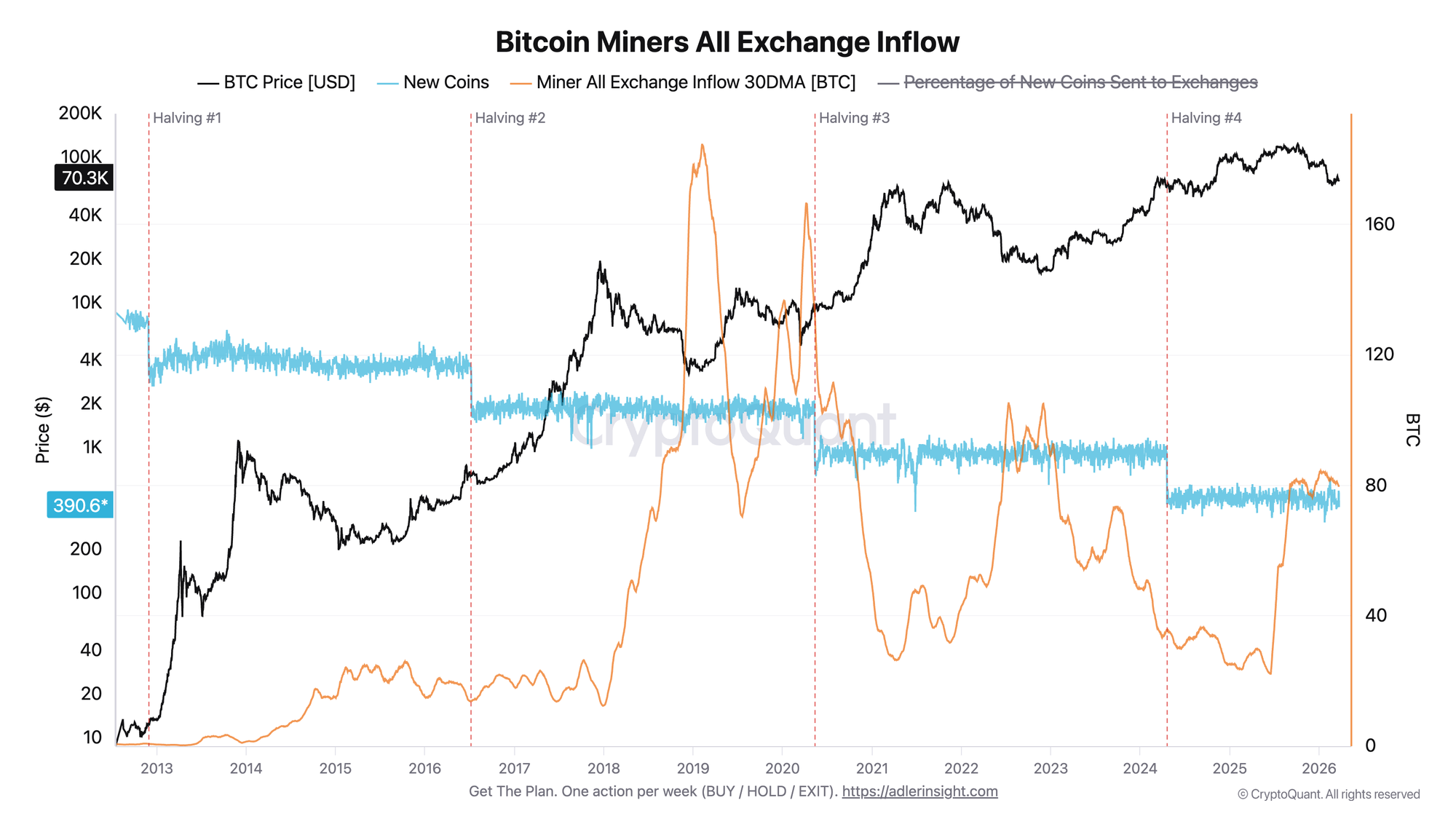
The metric reflects the 30-day moving average of BTC inflow from miners to all exchanges - one of the most direct indicators of current realized selling pressure from new issuance.
After Halving #4, miner exchange inflow noticeably increased compared to the early post-halving period. Since autumn 2025, the orange 30DMA line has risen sharply and by 2026 remained at elevated levels. This means that a significant portion of freshly mined supply is still being directed into the market, and current miner pressure cannot be considered removed.
In recent weeks the chart shows a local pullback from recent peaks. But against the backdrop of strong growth over recent months, this does not yet look like a confirmed downward reversal - rather a pause within a still-elevated exchange inflow regime. To speak of a real reduction in miner pressure, a more sustained decline of the 30DMA from the current elevated zone is needed, not a short oscillation within it.
Bitcoin OTC Address Cohort Balance
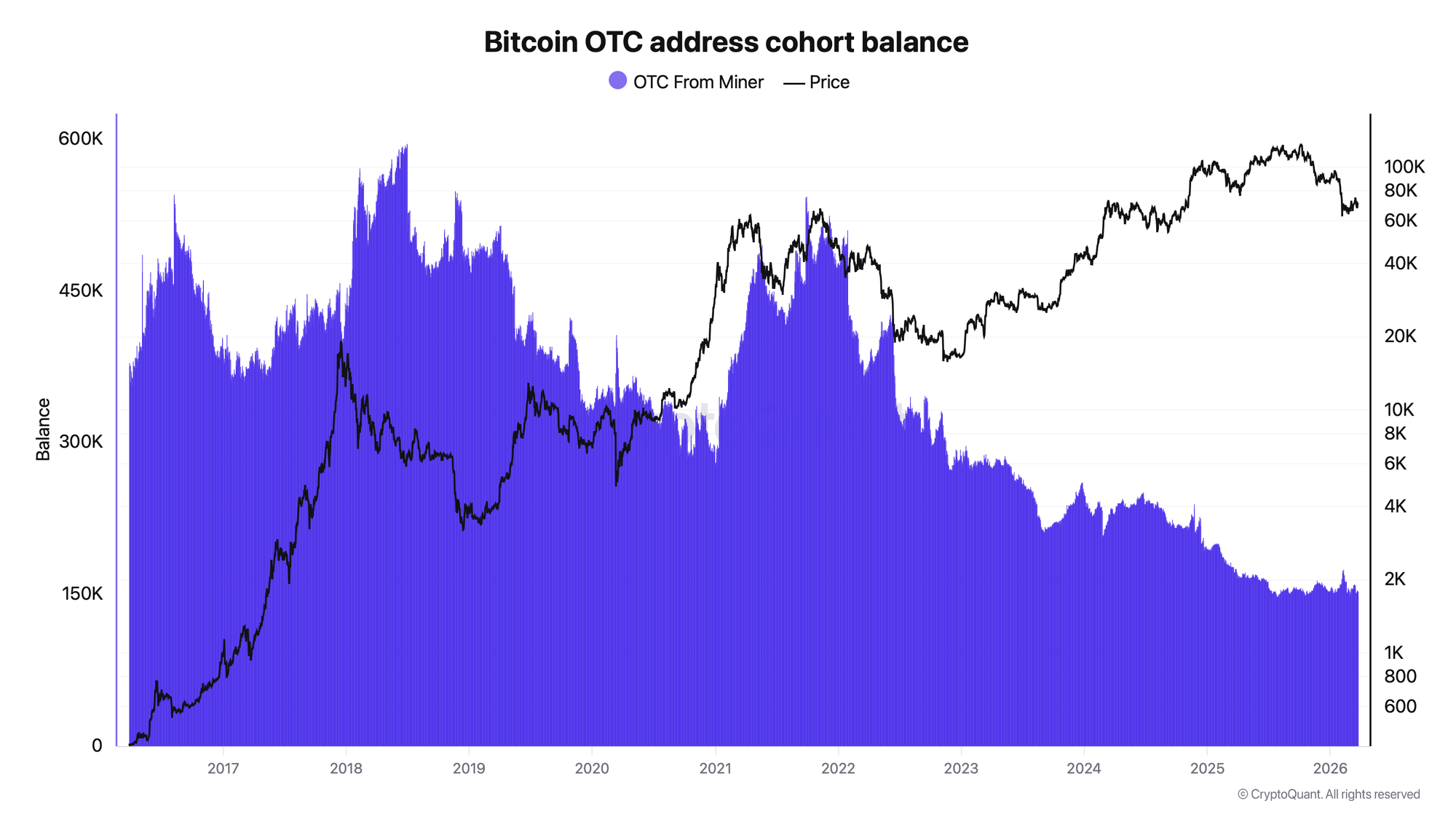
The metric tracks the aggregate BTC balance on OTC addresses associated with miners. This is not an indicator of immediate sales, but rather an estimate of the volume of coins that can be used for large over-the-counter deals.
By historical standards, miner OTC balances are indeed low. The metric peaked around 2018, when approximately 595K BTC was held on these addresses. The current balance stands at around 152.6K BTC, and the absolute minimum for the entire available series was recorded in July 2025 at around 146.9K BTC. In other words, the current level is close to the lower bound of the historical range, but claiming the buffer is "almost entirely exhausted" would be an overstatement: more than 150K BTC is still a significant volume.
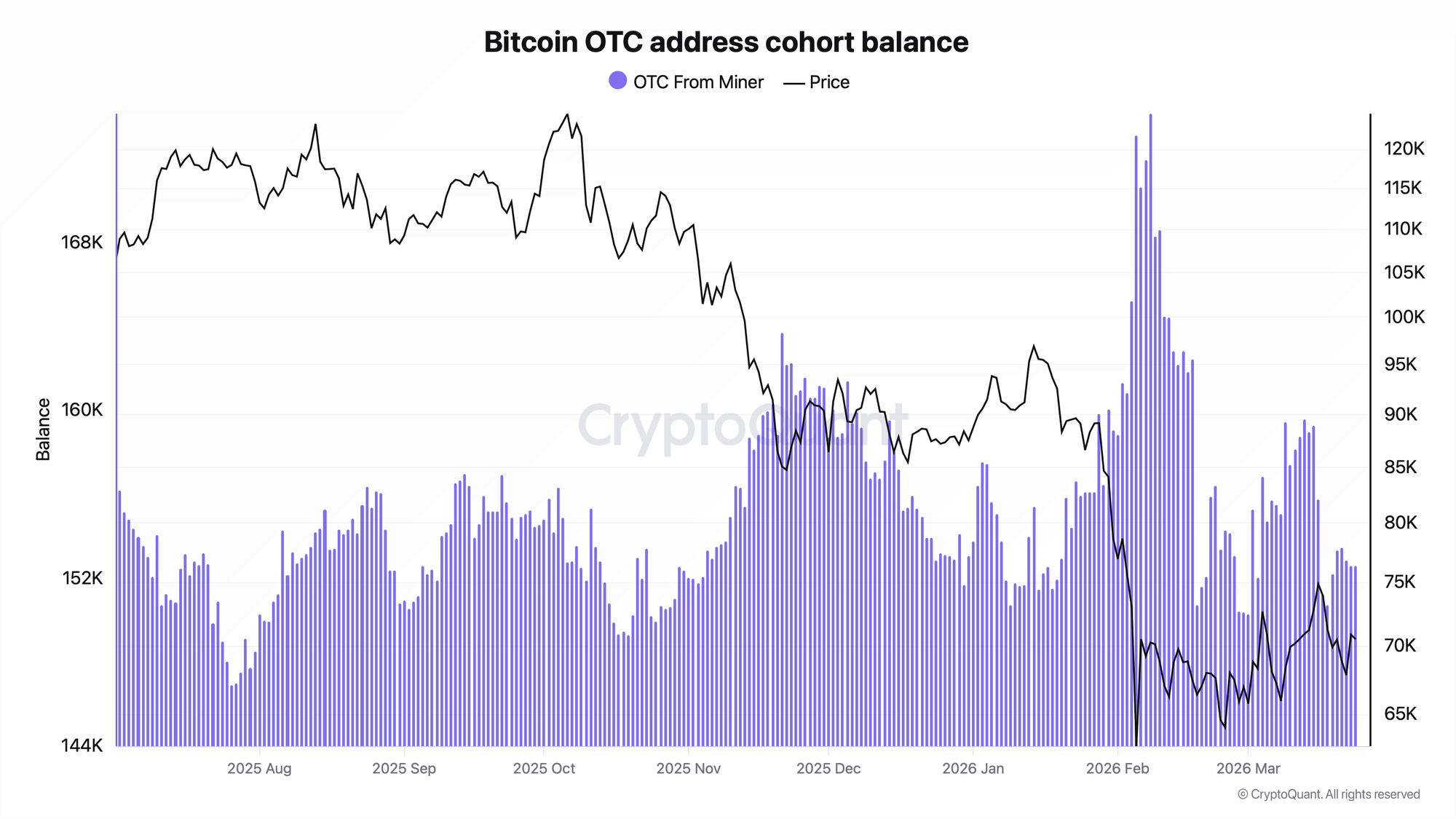
Looking at a shorter time horizon, the picture also does not support the thesis of complete depletion. In recent months the OTC balance has been oscillating within a relatively narrow range, and in February there was even a noticeable upward spike. This looks more like a regime of low but persisting reserve than a final phase of complete buffer depletion. Miners have substantially less OTC inventory than in past cycles, but the OTC reserve as a class has not disappeared. It simply no longer looks large enough to create the same hidden supply overhang the market could see previously.
Buy and Hold works until the wrong 30% drawdown destroys your confidence. Weekly Engine helps you stay exposed when conditions are healthy and step aside when risk starts rising - so you can follow a process instead of guessing under pressure. Start 7 days free.
FAQ
Why can we not say the OTC buffer is "exhausted"? Because associated OTC addresses still hold more than 150K BTC. This is low relative to historical peaks, but too much to describe the situation as complete depletion. It is more accurate to speak of a compressed or limited reserve, not a disappeared one.
What matters more for the market right now - OTC balance or exchange inflow? In the immediate term, exchange inflow matters more, because it shows current selling pressure that directly enters the market. OTC balance matters as structural context: it helps understand how large the remaining over-the-counter reserve is and whether miner supply can increase without pressure on the exchange.
CONCLUSIONS
Both charts point to a mixed picture. On one hand, miner OTC balances are indeed holding near multi-year lows relative to historical peaks of past cycles. This means the hidden over-the-counter supply reserve is no longer as large as before. On the other hand, the 30DMA of exchange inflow - after strong growth since autumn 2025 - is still elevated, meaning current selling pressure through exchanges persists.
The main takeaway: miners have an OTC reserve, but it no longer looks unlimited. At the same time, freshly mined coins are still actively flowing to exchanges. A positive reassessment of this factor will only come when exchange inflow begins to decline sustainably from current elevated levels.
Further Reading
If you want to go deeper on the metrics and frameworks behind today's analysis, here are the most relevant guides:
- Bitcoin Puell Multiple: Definition, Formula & Miner Signals - the core miner profitability framework
- Bitcoin Miner Reserve & Outflow: Tracking Selling Pressure - direct deep dive into miner selling mechanics
- Bitcoin Hash Ribbons: Capitulation Signals & Buy Triggers - miner stress and capitulation context
- Bitcoin Exchange Reserve: Definition, Formula & Cycle Signals - exchange-side supply dynamics
- Bitcoin Exchange Netflow: What It Is and How to Use It - how to read inflow/outflow pressure